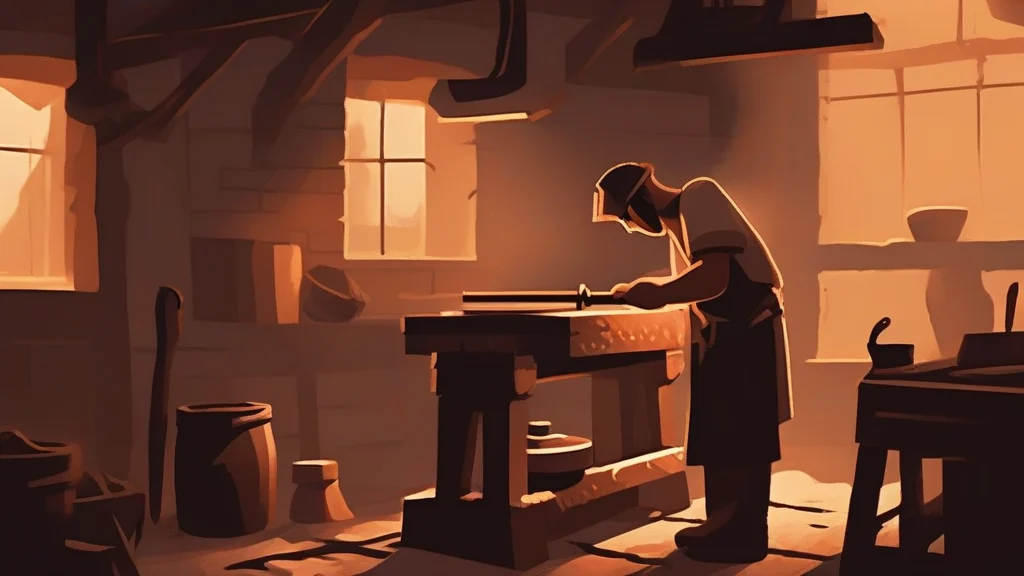
What does blacksmithing mean?
Blacksmithing is the craft of shaping metal — historically iron and steel — by heating it in a forge until it becomes malleable and then hammering it into form on an anvil. The name reflects both the material and the maker: a "blacksmith" worked with "black" metal, the dark iron left behind when heated, distinguishing him from the "whitesmith" who finished tin and pewter with cold, polished work. For centuries, blacksmithing was indispensable to daily life, producing everything from horseshoes, tools, and nails to weapons and architectural ironwork, which is why nearly every settlement had its own smith. Today the trade survives largely as an artisanal pursuit, practiced in workshops, taught in craft schools, and showcased at living-history museums. The word is an uncountable noun referring to the craft itself, and it evokes notions of skilled handiwork, tradition, and the enduring appeal of working directly with raw materials.
nounThe craft or trade of forging iron and other metals by heating them in a forge and shaping them with a hammer and anvil.
- The craft of shaping heated iron or steel using a forge, hammer, and anvil; the work done by a blacksmith.
"After retiring, he took up blacksmithing and now forges decorative iron railings by hand."
"She spent the summer apprenticing at a rural forge, learning the fundamentals of blacksmithing."
"The museum's living-history exhibit features live demonstrations of traditional blacksmithing techniques."
Every horseshoe, medieval sword, and pioneer wagon axle you've ever seen passed through the hands of someone practicing blacksmithing — a craft so essential that nearly every town in history had its own smith.
Reviewed by Deb Chak, Editor. AI-assisted content curated by RJS Tech Solutions LLP.
Etymology of blacksmithing
Blacksmithing derives from "blacksmith," a compound of "black" and "smith." The word "smith" comes from Old English "smið," meaning a worker in metal, a term of Germanic origin. The "black" element referred to the dark color of iron, especially the oxide scale that forms on its surface when heated, setting the blacksmith apart from whitesmiths who worked lighter-colored metals. The gerund form "blacksmithing" emerged to name the craft the blacksmith practices, and related compounds such as "goldsmith," "locksmith," and "gunsmithing" show how productive this formation has been across English.
How blacksmithing is actually used
The term is uncountable and refers to the activity or craft as a whole rather than individual objects. It carries connotations of traditional craftsmanship, physical labor, and heritage trades, and is often used in contexts involving artisan crafts, historical reenactment, and vocational training.
Easily confused with blacksmithing
Blackmagic refers to sorcery or the supernatural, while blacksmithing is the practical craft of forging metal; they share only the modifier "black".
Whitesmithing is the finishing of lighter metals such as tin or pewter with cold work and polishing, whereas blacksmithing involves forging heated iron at the anvil.