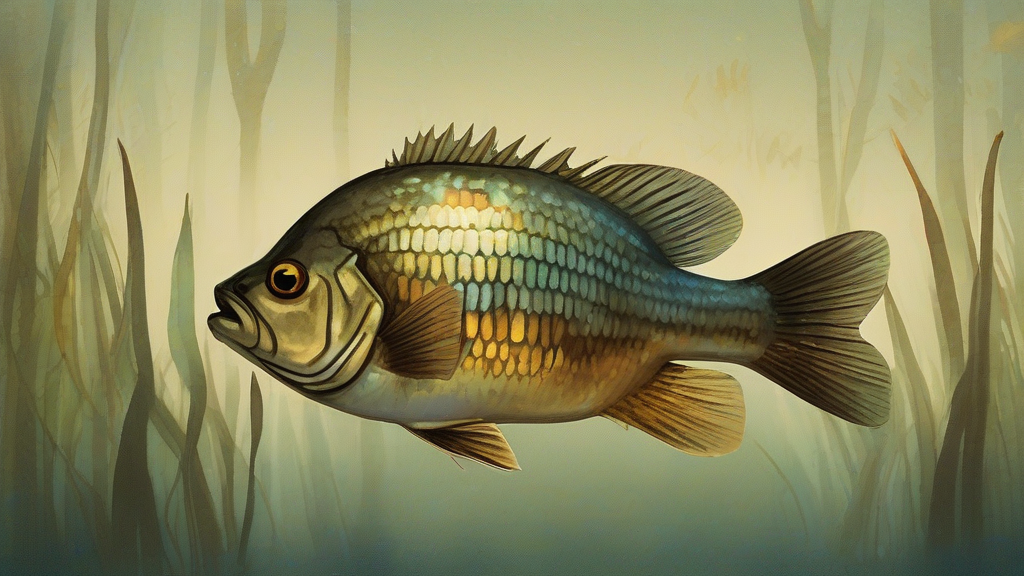
What does bluegill mean?
The bluegill is a small freshwater fish native to North America and one of the most widely recognized members of the sunfish family. Scientifically known as Lepomis macrochirus, it is easily identified by its deep, flattened body, blue-green shading along the back, dark vertical bars, and the small black flap at the rear edge of its gill cover that gives the species its name. Bluegills thrive in ponds, lakes, and slow-moving streams across the United States and beyond, where they feed on insects, larvae, and small crustaceans. Because they are abundant, willing biters, and good to eat, they hold a special place in American angling culture, often serving as the first fish a child catches. In casual Southern speech they are frequently called bream or brim. Beyond recreation, bluegills are important in fisheries management and ecology as both prey and competitors in freshwater food webs.
nounA small North American freshwater sunfish (Lepomis macrochirus) with a blue-green back, dark vertical bars, and a distinctive black flap on its gill cover, popular as a panfish among anglers.
- A small freshwater sunfish of North America (Lepomis macrochirus), prized as an angling and panfish species.
- Informally, any similar small sunfish caught for food or sport in North American lakes and ponds.
"The kids spent the afternoon catching bluegill off the dock at the lake."
"He filled his stringer with bluegill before the morning fog lifted off the lake."
"Biologists surveyed the pond and found the bluegill population thriving after the habitat restoration."
The standard plural adds -s. When referring to the fish as food in bulk, the singular can be used collectively (e.g., "a mess of bluegill").
"The shallows were teeming with bluegills during the spring spawn."
A single female bluegill can release tens of thousands of eggs in one spawning season, which is why they can crowd a pond seemingly overnight.
Reviewed by Deb Chak, Editor. AI-assisted content curated by RJS Tech Solutions LLP.
Etymology of bluegill
The name bluegill is a straightforward English compound formed from "blue," referring to the fish's iridescent blue-green coloration, and "gill," referring to the respiratory organ and, in this case, the dark flap on the gill cover. Both elements are long-established English words — "gill" ultimately deriving from Old Norse "gil" via Middle English — combined in American English once European settlers encountered and named the fish's native waters. It is a descriptive vernacular name rather than one with deep classical roots.
Related word forms
How bluegill is actually used
"Bluegill" is chiefly American usage, common in angling, wildlife management, and outdoor writing; in parts of the American South it is colloquially called "bream" or "brim." The word is used almost exclusively in concrete reference to the fish rather than figuratively.
Easily confused with bluegill
Crappie is a larger, more elongated sunfish relative with silvery speckled coloring and a bigger mouth, whereas the bluegill is smaller, deeper-bodied, and marked by a black ear flap.
The pumpkinseed sunfish has bright orange spots and a red-edged ear flap, while the bluegill is generally darker blue-green with a plain black flap.