What does bosk mean?
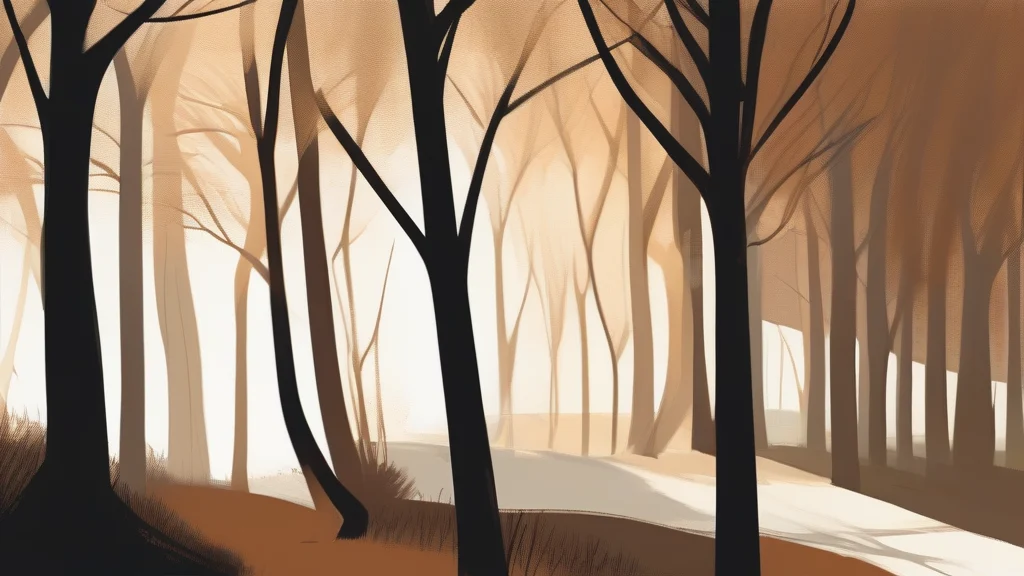
Bosk is a noun meaning a small wood, grove, or thicket of trees — a compact stand of trees smaller than a forest and denser than scattered woodland. The word belongs to an old family of terms for modest patches of trees, alongside copse, spinney, and covert, all of which evoke enclosure and shade rather than vast timberland. In modern usage bosk is rare and distinctly literary: it appears most often in poetry, nature writing, and historical or pastoral fiction, where its slightly antique flavor suits descriptions of quiet, sheltered green places. Its derivative adjective, bosky — meaning woody or covered with trees — enjoys a somewhat longer life in elegant descriptive prose, as in "a bosky hollow." Writers reach for bosk precisely because it sounds older and more atmospheric than plain "grove," lending a scene a sense of seclusion and timelessness.
nounA small wood or thicket of trees; a grove.
- A small wood or thicket; a clump of trees or shrubs.
"They pitched their tent beside a shady bosk at the edge of the meadow."
"The path disappeared into a dark bosk of hawthorn and elder."
"From the hilltop they could see a lone bosk standing amid the open fields."
Regular pluralization; typically used when describing multiple small groves across a landscape.
"The valley floor was dotted with small bosks of oak and ash."
Bosk gave us 'bosky' — the poet's word for leafy shade — making it one of the few nouns whose adjective outlived it in everyday literary use.
Reviewed by Deb Chak, Editor. AI-assisted content curated by RJS Tech Solutions LLP.
Etymology of bosk
Bosk comes into Middle English from forms shared by Old Norse and Middle Dutch (compare Dutch bosch, meaning "wood"), ultimately connected to the same Germanic root that produced the everyday word "bush." The word has been in use since medieval times and remained current through the early modern period before fading into literary use. Related borrowings include the French-derived bosquet and Spanish bosque, both denoting small groves, while the English derivatives boscage (brushwood or woodland) and bosky grew directly from bosk itself.
Related word forms
How bosk is actually used
"Bosk" is rare and chiefly literary or archaic in modern English, carrying a somewhat poetic connotation of sheltered, leafy seclusion. The derived adjective "bosky" survives more actively in descriptive prose.
Easily confused with bosk
To busk means to perform music or entertainment in a public place for donations, whereas a bosk is a small grove of trees.