
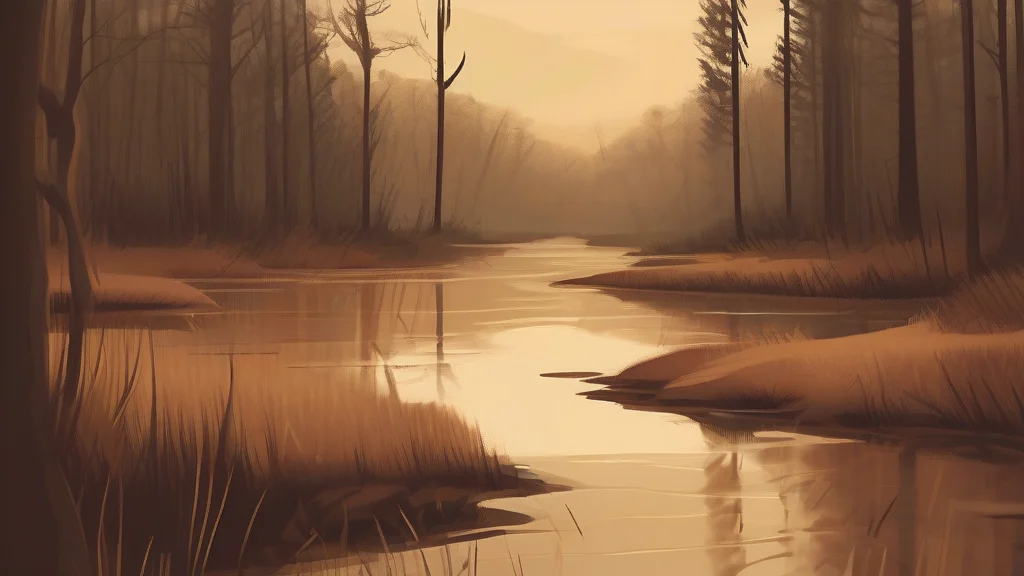
What does bottomland mean?
Bottomland refers to the low-lying land found along rivers and streams — the flat ground at the bottom of a river valley that floods periodically when water levels rise. In North America, the term is especially common among farmers, foresters, and ecologists, who value bottomland for its deep, fertile alluvial soils deposited by repeated flooding. Bottomland hardwood forests, dominated by oaks, cottonwoods, and other moisture-loving trees, once covered vast stretches of the Mississippi Valley and remain ecologically important for flood control and wildlife habitat. Because these areas are productive but vulnerable to inundation, land use decisions there often balance agriculture against conservation. The plural form, bottomlands, appears frequently in descriptions of regional landscapes.
nounLow-lying land adjacent to a river or stream that is periodically flooded when the water level rises; land on the floor of a river valley.
- Low-lying land along a river or stream that floods periodically, especially valued for its fertile alluvial soil.
- More generally, the lowest ground in a river valley or drainage basin.
"The cottonwoods along the river grew tallest in the fertile bottomland, where spring floods left behind rich sediment."
"The old-growth hardwood forests of the Mississippi bottomland were largely cleared for farmland in the nineteenth century."
"After the heavy rains, the cattle were moved to higher pasture because the bottomland was under water."
Commonly used in the plural when referring to such areas across a region or landscape.
"The river's broad bottomlands support some of the richest farmland in the state."
Farmers have prized bottomland for centuries because every flood delivers a free layer of fresh, nutrient-rich soil — nature's own fertilizer.
Reviewed by Deb Chak, Editor. AI-assisted content curated by RJS Tech Solutions LLP.
Etymology of bottomland
Bottomland is a straightforward compound of 'bottom' and 'land', formed within English. It emerged in American English, where settlers used it to describe the low river-valley ground they cleared and farmed. The word reflects the same naming pattern seen in compounds like 'lowland' and 'upland'.
How bottomland is actually used
Bottomland is chiefly an American term, common in agricultural, ecological, and forestry contexts. It often carries a positive connotation of fertility and productivity, as in 'rich bottomland.' The plural 'bottomlands' is frequently used when referring to such areas collectively across a region.
Easily confused with bottomland
A floodplain is any land subject to flooding by a river, while bottomland specifically refers to the low ground at the bottom of a river valley, often used in American agricultural and ecological contexts.
Swampland is waterlogged land supporting marsh vegetation, whereas bottomland may be well-drained most of the year and is defined by its position in a river valley rather than permanent wetness.