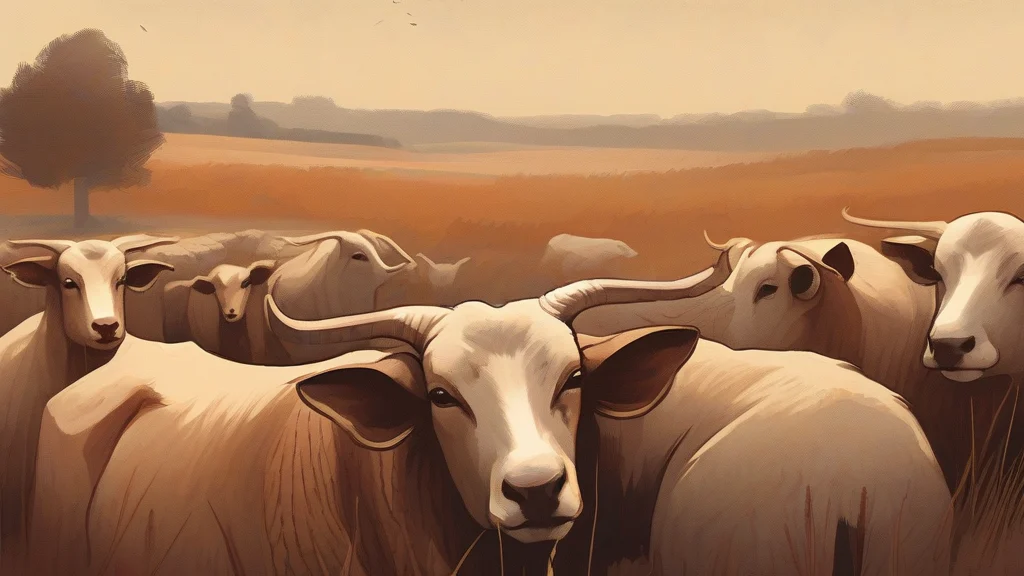
What does bovid mean?
A bovid is any member of Bovidae, one of the largest and most widespread families of hoofed mammals. The family embraces a remarkable range of animals: domestic cattle, sheep, and goats, together with wild species such as antelopes, gazelles, buffaloes, bison, wildebeest, and musk oxen. All bovids are ruminants — they chew cud and possess specialized stomachs for digesting tough plant matter — and most bear unbranched horns that persist throughout life, typically larger in males. Because the word is a formal zoological term, it appears chiefly in scientific literature, wildlife documentaries, and academic discussion rather than daily conversation; a speaker would normally say "goat" or "antelope" rather than "bovid." Still, it is a precise and useful term for anyone writing about mammals, evolution, or ecosystems, since it groups together animals as outwardly different as a dairy cow and a springbok under one evolutionary banner. Its adjectival relative, "bovine," refers more narrowly to cattle.
nounA mammal belonging to the family Bovidae, a large group of ruminants that includes cattle, sheep, goats, antelopes, and buffalo.
- Any mammal of the family Bovidae, comprising cloven-hoofed ruminants such as cattle, sheep, goats, antelopes, buffalo, bison, and musk oxen.
"The wildebeest, though it looks unlike a cow, is in fact a bovid."
"The savanna teemed with bovids, from towering elands to diminutive dik-diks."
"Genetic studies suggest the domestic yak diverged from other wild bovids several million years ago."
Regular plural; used when referring to multiple members of the family or to the family collectively in ecological or paleontological contexts.
"The reserve protects over twenty species of bovids, from oryx to waterbuck."
If you've ever petted a goat, admired a gazelle, or eaten beef, you've crossed paths with a bovid — one of the most successful mammal families on Earth.
Reviewed by Deb Chak, Editor. AI-assisted content curated by RJS Tech Solutions LLP.
Etymology of bovid
The word "bovid" derives from New Latin Bovidae, the scientific family name formed from Latin bos, bovis, meaning "ox" or "cow." This Latin noun descends from the Proto-Indo-European root *gʷōus, which also produced Greek bous and ultimately English words such as "bovine," "beef," and "bucolic" (via Greek boukolos, "cowherd"). The English term arose in the nineteenth century alongside modern biological classification, when naturalists needed a collective label for the family Linnaeus and later taxonomists had defined.
How bovid is actually used
Primarily a technical term used in zoology, ecology, paleontology, and scientific writing rather than everyday conversation. In casual speech, speakers usually name the specific animal instead.
Easily confused with bovid
"Bovid" refers to any member of the family Bovidae (including sheep, goats, and antelopes), while "bovine" more narrowly relates to cattle or oxen and also serves as an adjective meaning dull or sluggish.