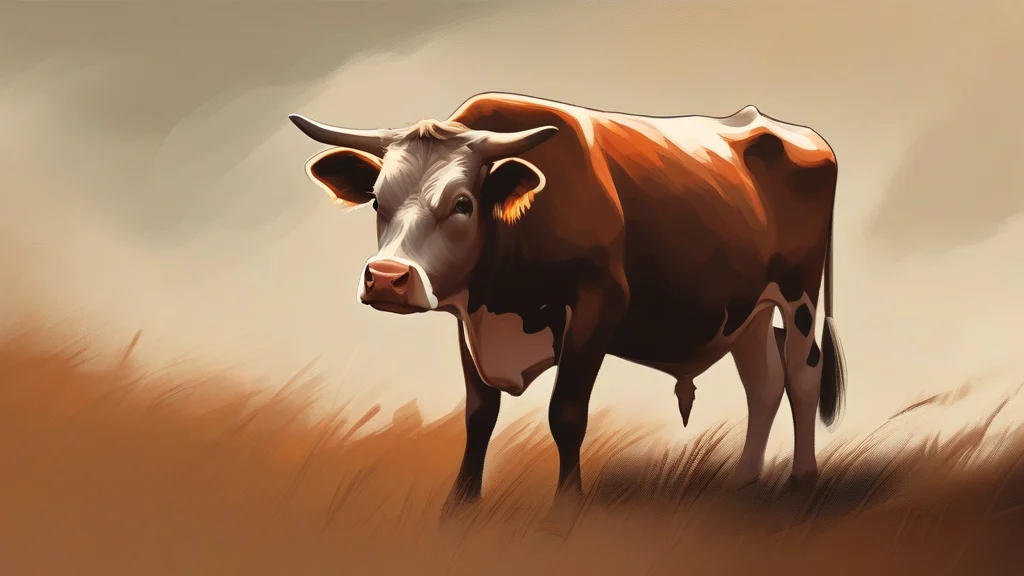
What does bovine mean?
Bovine means relating to cattle — animals of the genus Bos, which includes domestic cows, oxen, and related beasts such as buffalo. It appears constantly in veterinary and agricultural language: bovine tuberculosis, bovine growth hormone, and bovine spongiform encephalopathy (the formal name for mad cow disease) are all established terms. Beyond its literal scientific use, bovine has a vivid figurative life: describing a person's gaze or manner as bovine suggests a slow, patient, uncomprehending quality reminiscent of an ox staring at a fence post, which makes the word faintly insulting when aimed at people. It also functions as a noun meaning simply a member of the cattle family. Derived from the Latin bos, meaning ox or cow, bovine belongs to a small elegant family of animal adjectives that includes equine (horses), ovine (sheep), and feline (cats). It lends writing a precise, slightly formal tone wherever livestock are involved.
Relating to or affecting cattle; belonging to the group of ruminant mammals that includes domestic cattle.
"The laboratory tests confirmed bovine tuberculosis in one of the herd."
Standard in veterinary, agricultural, and scientific writing.
An animal of the cattle group; a member of the genus Bos or the broader family Bovidae.
"The pasture was dotted with a dozen placid bovines grazing in the afternoon sun."
Plural form is regular: bovines. Common in zoological and descriptive contexts, rare in casual speech.
Regular English plural. Applies only to the noun sense meaning cattle animals.
"The rancher counted his bovines before the storm rolled in."
When scientists needed a formal name for mad cow disease, they reached for Latin and got 'bovine spongiform encephalopathy' — the word 'bovine' has been doing serious scientific work ever since.
Reviewed by Deb Chak, Editor. AI-assisted content curated by RJS Tech Solutions LLP.
Etymology of bovine
Bovine derives from the Latin bos, meaning ox or cow, via the stem bov- found in forms like bovis. It entered English as an adjective in the early 19th century, following the pattern of other learned animal adjectives formed on Latin roots, such as equine from equus and ovine from ovis. The same Latin root underlies bucolic (from Greek boukolos, herdsman, itself borrowed from a cognate) and connects to the zoological term Bovidae, the family name for cattle, goats, and antelopes.
Related word forms
How bovine is actually used
In scientific, veterinary, and agricultural contexts 'bovine' is strictly neutral and technical. In everyday speech it is often used figuratively and can carry a mildly insulting connotation when applied to people, implying slowness or placid stupidity — use with care. The noun form is less common than the adjective but standard in zoology.
Easily confused with bovine
Ovine means relating to sheep, while bovine means relating to cattle.
Equine refers to horses, whereas bovine refers to cattle.