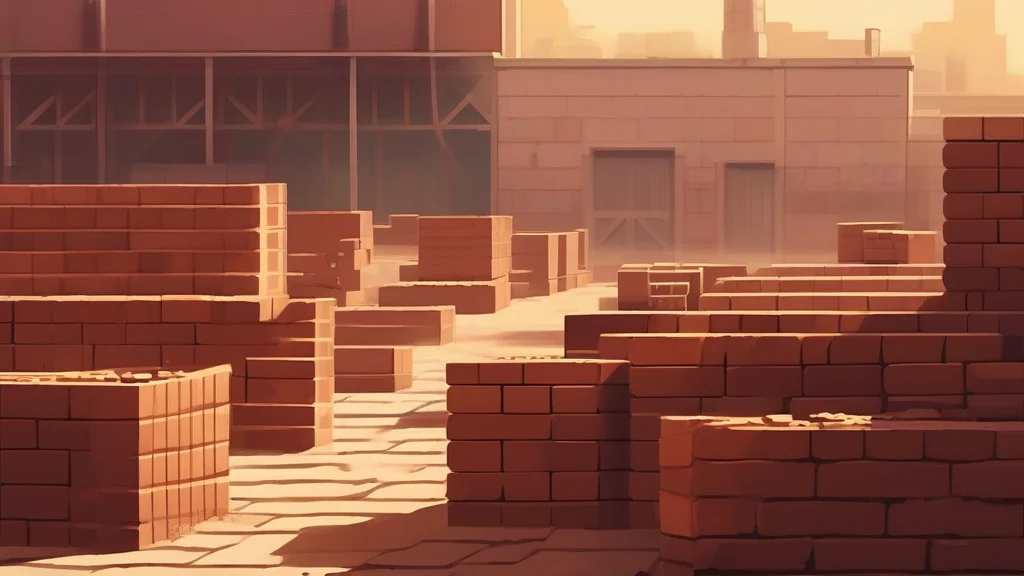
What does brickyard mean?
A brickyard is a place where bricks are made, fired in kilns, and stored or sold — historically an open yard beside a clay pit, since transporting heavy bricks was costly and production was best done close to the raw material. The word combines 'brick,' which entered English from Middle Dutch or Middle Low German, with 'yard,' meaning an enclosed outdoor area. Brickyards were once a fixture of towns across Britain and North America, employing generations of workers and supplying material for local construction; many have since closed, leaving behind pits, chimneys, and kilns that are often repurposed as parks, nature reserves, or industrial heritage sites. Today the word appears both in literal reference to working brickyards and in place names and historical contexts. It is a plain, concrete term with no figurative uses, and its British counterpart 'brickworks' is broadly interchangeable with it.
nounA place, typically an open yard or works, where bricks are made, stored, or sold.
- A yard or works where bricks are manufactured, fired, or stored.
- A business or site where bricks are sold.
"The old brickyard by the river had been abandoned for decades before artists converted its kilns into studios."
"Her grandfather worked at the brickyard for forty years, hauling clay from the pit to the kilns."
"The contractor ordered a full pallet load directly from the brickyard to match the original 1920s facade."
Regular plural; commonly used when discussing multiple sites or the industry as a whole.
"Dozens of brickyards once lined the river valley, each with its own clay pit and kilns."
Many of America's oldest city parks and arts districts — from Chicago's Brickyard to countless converted kilns — began as working brickyards that fired the very buildings around them.
Reviewed by Deb Chak, Editor. AI-assisted content curated by RJS Tech Solutions LLP.
Etymology of brickyard
Brickyard is a straightforward English compound of 'brick' plus 'yard.' The element 'brick' came into Middle English from Middle Dutch or Middle Low German (compare Dutch 'brik'), likely via Flemish brickmakers working in England, while 'yard' derives from Old English 'geard,' meaning an enclosure or dwelling area. The compound emerged as brickmaking became an organized industry, describing the enclosed site where clay was dug, molded, dried, and fired. It shares its first element with related terms such as 'bricklayer,' 'brickwork,' and 'firebrick.'
Related word forms
How brickyard is actually used
Brickyard is a concrete, everyday compound noun with no strong register — equally at home in historical writing about industrial sites and in casual speech. In British English the near-synonym 'brickworks' is somewhat more common, while 'brickyard' predominates in American usage. It carries mild nostalgic or industrial connotations when used of defunct sites.
Easily confused with brickyard
Brickyard is a place where bricks are made or stored, while brickwork refers to construction built from bricks, such as a wall or masonry.