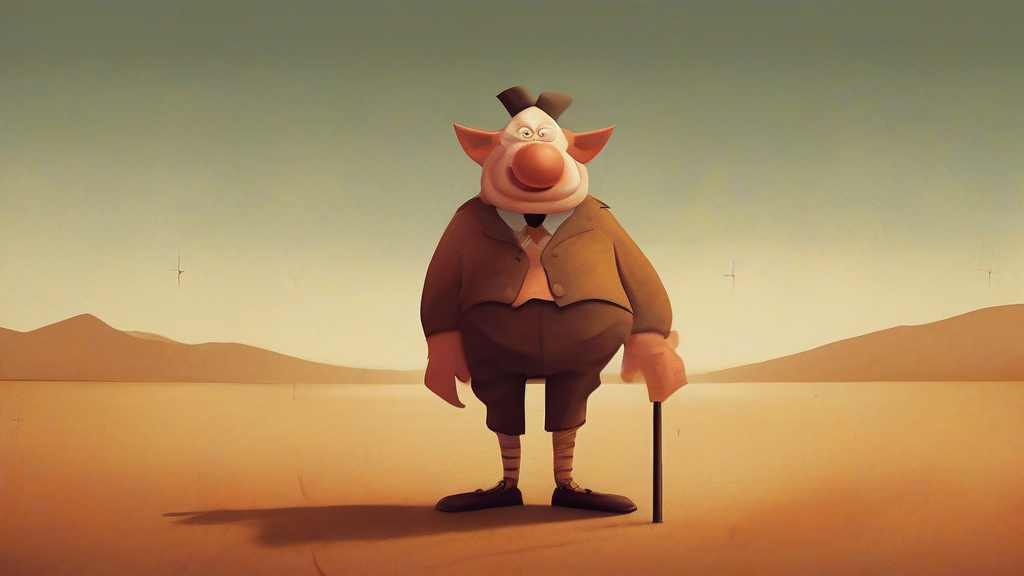
What does buffoon mean?
A buffoon is a person who behaves in a ridiculous, clownish manner, often drawing laughter at the expense of their own dignity. The word can describe anyone from a slapstick comedian to a public figure whose conduct strikes observers as absurd and undignified, and it carries an almost invariably mocking connotation today. Historically, however, a buffoon had an honoured role: in the courts of Renaissance Italy and elsewhere, professional jesters entertained rulers with jokes, mime, and satire, sometimes enjoying unusual freedom to speak truth through comedy. The word entered English in the sixteenth century from French bouffon, ultimately from Italian buffone, related to the verb buffare, 'to puff' — evoking the exaggerated expressions of comic performers. Related forms include 'buffoonish', describing clownish behaviour, and 'buffoonery', the practice of such antics. Common collocations include 'play the buffoon' and 'drunken buffoon'. Whether describing a court jester of old or a politician caught posturing, calling someone a buffoon is rarely kind — it suggests foolishness worn openly and without shame.
nounA ridiculous but amusing person who behaves in a silly, clownish way, especially in public; historically, a professional jester who entertained a ruler or court with jokes and physical comedy.
- A person who amuses others by ridiculous or clownish behaviour; a fool.
- A professional entertainer or jester at a royal court, especially in Renaissance Italy and France.
"The debate degenerated into farce as each candidate tried to outdo the other as a buffoon."
"He made a buffoon of himself stumbling drunkenly across the stage."
"In the courts of Renaissance Italy, the buffoon was licensed to mock even the prince himself."
Regular plural; used both literally for jesters and figuratively for foolish people.
"The play's clowns were buffoons in the old courtly tradition."
The word 'buffoon' traces back to an Italian verb meaning 'to puff' — the puffed cheeks of comic pantomime gave us one of English's sharpest insults for a public fool.
Reviewed by Deb Chak, Editor. AI-assisted content curated by RJS Tech Solutions LLP.
Etymology of buffoon
'Buffoon' entered English in the mid-sixteenth century via French bouffon, borrowed from Italian buffone, meaning a jester or mocker. The Italian noun derives from buffare, 'to puff out the cheeks', a vivid image of comic pantomime. Its cognates include the musical terms buffo and opera buffa ('comic opera'), and, more distantly, the fashion term bouffant.
Related word forms
How buffoon is actually used
Almost always derogatory when applied to a modern person, implying undignified, self-important silliness rather than harmless fun. 'Play the buffoon' is a fixed expression meaning to behave deliberately like a fool. The derived noun 'buffoonery' refers to clownish conduct or performance.
Easily confused with buffoon
A baboon is a large monkey; 'buffoon' is a person acting foolishly — the two are sometimes confused in spelling despite entirely different meanings.