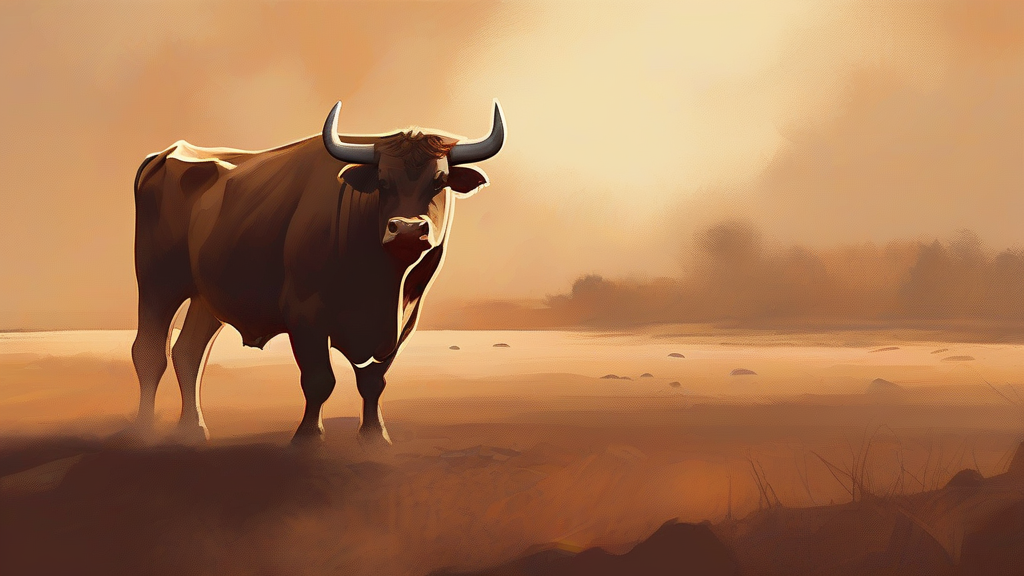
What does bull mean?
A bull is an adult male of cattle or certain other large mammals, including the elephant, whale, and seal. The word is central to many cultural practices, from bullfighting in Spain to rodeos in North America, and appears in numerous idioms: to take the bull by the horns means to confront a problem directly, while a bull in a china shop describes someone who is clumsy or tactless. In financial contexts, a bull is an investor who believes prices will rise, making 'bullish' shorthand for optimism about markets. As a verb, to bull is to push or shove with force, reflecting the animal's characteristic strength and aggression. The word carries connotations of power, stubbornness, and sometimes recklessness. Its versatility across literal, figurative, and idiomatic uses has made it a durable and expressive part of English vocabulary for centuries.
An adult uncastrated male of cattle.
"The prize bull won first place at the county fair."
Distinguished from a steer, which is a castrated male.
The male of any large mammal, especially whales, seals, and elephants.
"The dominant bull walrus defended his harem on the beach."
(Finance) A person who buys securities expecting prices to rise; a bull market is a period of rising prices.
"Bulls dominated the exchange during the tech boom."
(Informal, chiefly US) Nonsense or insincere talk.
"That's just bull — he never intended to show up."
Considered informal and mildly vulgar when used as an expletive.
Standard plural; used for multiple male animals, or figuratively for bullish investors.
"Several bulls grazed peacefully in the meadow."
On Wall Street, a rising market is called a bull market — supposedly because a bull strikes upward with its horns, while a bear swipes downward with its paws.
Reviewed by Deb Chak, Editor. AI-assisted content curated by RJS Tech Solutions LLP.
Etymology of bull
The word 'bull' comes from Old English 'bula', which is related to Old Norse 'bolli' and may ultimately derive from a Germanic root meaning 'to swell' or referring to roaring. It has cognates in other Germanic languages, including Dutch 'bul' and German 'Bulle'. The sense of a male of large animals other than cattle developed by extension. The financial sense of a bullish investor emerged in the early 18th century, likely connected to earlier slang uses.
Related word forms
How bull is actually used
In informal American English, 'bull' alone can mean nonsense, though this usage is somewhat dated. In finance, 'bull' contrasts with 'bear' and carries an optimistic connotation. The word is common across registers, from farming and zoology to finance and idiomatic speech.
Easily confused with bull
A bulldozer is a machine for pushing earth; 'bull' as a noun refers to the animal, though both derive from the idea of forceful pushing.