What does busk mean?
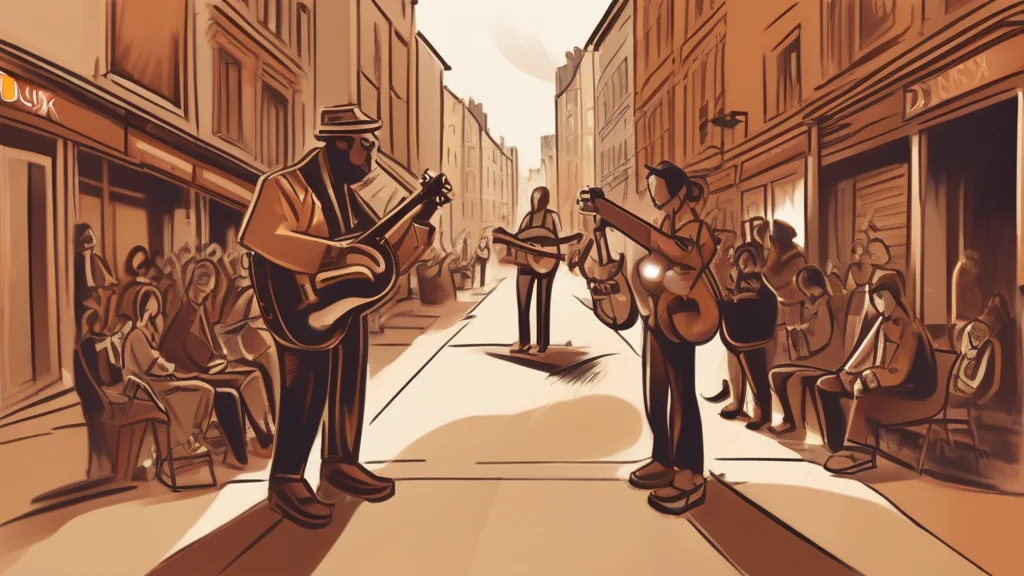
To busk is to perform in a public place — most often playing music, singing, juggling, or doing other street entertainment — in order to earn money directly from passers-by. The practice and its vocabulary are especially associated with Britain and the Commonwealth: a performer who busks is called a busker, and their activity is known as busking. Typical venues include subway stations, pedestrian streets, and markets, where performers play beside an upturned hat or open instrument case. The word carries no negative connotation; while informal, it simply describes a long-standing form of independent street work, and many celebrated musicians began their careers busking. In modern usage, 'busk' almost always means this kind of public performance, though historically it had separate meanings — an archaic verb meaning to prepare or equip oneself, and a noun for the rigid strip used to stiffen the front of a corset — both now rare outside historical or fashion contexts.
verbTo perform music or entertainment in a public place for donations from passers-by.
- To entertain in a public place, typically by playing music or performing, in the hope of receiving money from passers-by.
"The violinist spent the afternoon busking outside the tube station, drawing a small crowd with her renditions of Vivaldi."
"A young guitarist was busking beneath the arches, his open case scattered with coins."
"She decided to busk through Europe over the summer, funding her travels one crowd at a time."
The word 'busker' may trace back to the Spanish buscar — 'to seek' — so every street performer is literally 'seeking' their living from passers-by.
Reviewed by Deb Chak, Editor. AI-assisted content curated by RJS Tech Solutions LLP.
Etymology of busk
The street-performance sense of 'busk' emerged in English around the late 19th century, and its deeper origins are debated; one widely cited account links it to the Spanish verb buscar, meaning 'to seek', suggesting the idea of seeking one's livelihood from the public. It is unrelated to the older noun 'busk', which came via French from Italian and ultimately from Latin buxus ('box tree'), referring to the boxwood strips once used to stiffen corsets. A third, now obsolete verb 'busk', borrowed from Old Norse, meant to prepare or make oneself ready.
Related word forms
How busk is actually used
'Busk' in this performance sense is chiefly British and Commonwealth English; American speakers more often say 'street perform' or refer to 'buskers' only when adopting the British term. The verb is informal but entirely neutral in connotation. Note that 'busk' also exists as an archaic verb meaning to prepare or make oneself ready, and as a noun denoting the stiffening strip in a corset — both now largely historical.