
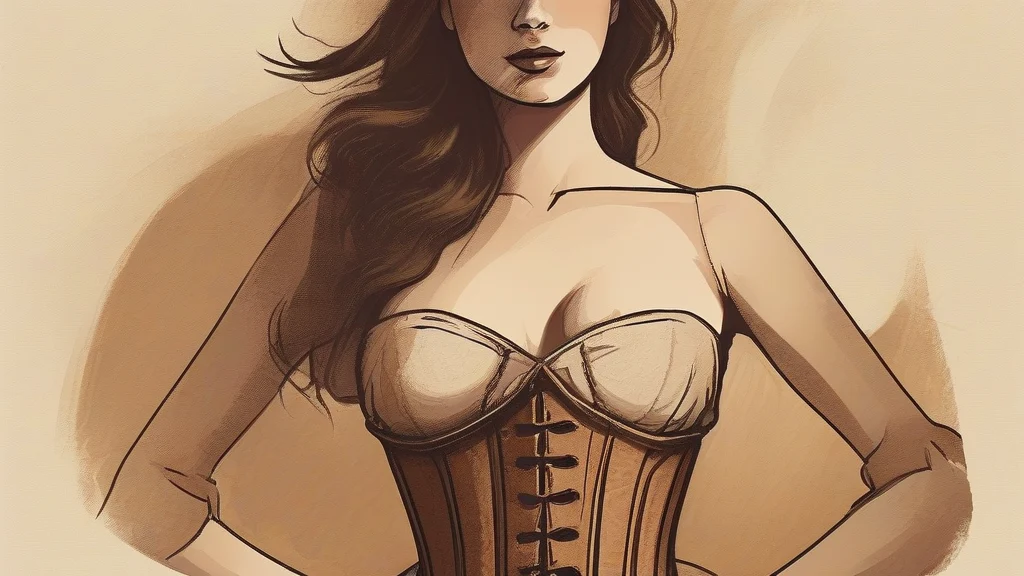
What does bustier mean?
A bustier is a close-fitting garment worn by women that covers the breasts and usually extends to the waist, shaping and supporting the upper body. Structurally it resembles a shortened corset, often stiffened with boning and fastened with hooks, lacing, or elastic. Historically an article of lingerie worn beneath clothing, the bustier has become a visible fashion statement in its own right, appearing in evening wear, bridal attire, and haute couture, sometimes layered over blouses or dresses. The word derives from the French 'buste', meaning 'bust', reflecting the garment's function of framing the torso. In everyday use, 'bustier' carries connotations of elegance, glamour, and femininity, and it is firmly established in both British and American English. Its plural form is 'bustiers', and it should not be confused with the unrelated noun 'bust' in its sense of a sculptural portrait.
nounA close-fitting garment worn by women that covers the bust and typically the torso down to the waist, often boned and laced like a short corset.
- A fitted, often boned garment covering the bust and torso, worn as underwear or as outerwear in fashion.
"She wore an embroidered silk bustier under her tailored jacket."
"For the gala, she paired a black satin bustier with a floor-length skirt."
"The designer's spring collection featured structured bustiers worn over crisp white shirts."
Standard regular plural; used when referring to multiple garments, as in retail or fashion contexts.
"The boutique stocked lace bustiers in several colors."
The word 'bustier' comes straight from the French word for 'bust' — making it one of fashion's most literally named garments.
Reviewed by Deb Chak, Editor. AI-assisted content curated by RJS Tech Solutions LLP.
Etymology of bustier
The English word 'bustier' was borrowed directly from French, where it derives from 'buste', the French term for the human bust or upper torso. It entered English usage in the twentieth century as the garment itself gained popularity as a form-fitting alternative to longer corsetry. Its closest etymological relative in English is the noun 'bust', which came through the same French source.
How bustier is actually used
Originally an item of lingerie, the bustier has since crossed into outerwear and high fashion, so register ranges from intimate apparel to runway wear. The plural is 'bustiers'.
Easily confused with bustier
A 'bust' can mean a woman's chest or a sculpted head-and-shoulders figure, while a 'bustier' is a specific garment worn on the upper body.