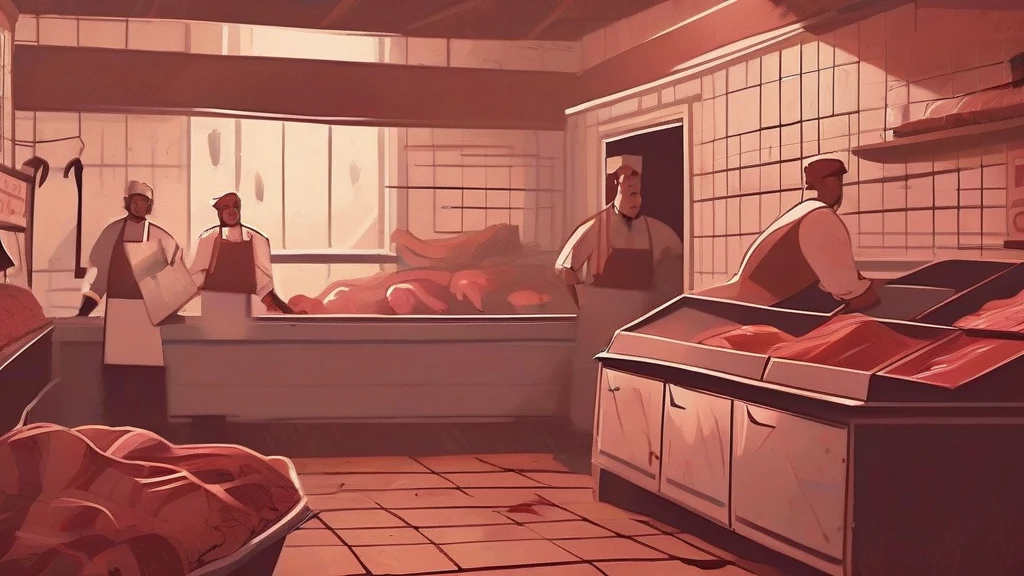
What does butcher mean?
A butcher is a person whose trade involves the slaughter of animals and the cutting, preparation, and sale of their meat. Traditionally working from a butcher's shop or meat counter, butchers are skilled craftspeople who break down carcasses into retail cuts such as chops, steaks, and joints. The word also has two important figurative uses: it can describe someone responsible for savage or indiscriminate killing — as in historical labels like 'the Butcher of X' applied to brutal rulers — and, as a verb, it means to ruin or mutilate something through clumsy handling, as when a performer 'butchers' a well-known song. The noun is entirely neutral in everyday contexts, while these figurative uses carry sharply negative connotations of violence or incompetence. The term derives ultimately from an Old French word connected to a male goat, reflecting the medieval origins of the trade.
A person who slaughters animals and cuts up and sells their meat.
"Ask the butcher for a bone-in shoulder roast."
Also used figuratively for a person guilty of cruel or reckless killing.
To slaughter an animal for meat; figuratively, to ruin or botch something badly.
"The band was criticised for butchering the national anthem at the opening ceremony."
Informal register when used figuratively.
Standard plural. 'The butcher's' commonly refers to a butcher's shop using the singular possessive.
"Several butchers set up stalls at the Saturday market."
The word 'butcher' literally traces back to an old word for a male goat — the original butchers were goat-sellers in medieval France.
Reviewed by Deb Chak, Editor. AI-assisted content curated by RJS Tech Solutions LLP.
Etymology of butcher
The English word 'butcher' comes from the Old French 'bochier' (later 'bouchier'), meaning one who slaughters goats, which itself derives from 'boc', meaning a male goat. It entered Middle English in the medieval period as the meat trade became organised in European towns. The French cognate 'boucher' survives in modern French with the same occupational meaning. The ultimate root is related to other Germanic words such as English 'buck'.
Related word forms
How butcher is actually used
As a noun, 'butcher' is neutral in everyday speech when referring to the trade. When used figuratively for a person ('a butcher of men'), it carries strong negative connotations of cruelty or incompetence. As a verb, 'to butcher' is informal-to-neutral in register but strongly negative in meaning, implying careless destruction of something valued.
Easily confused with butcher
A botcher is someone who does a job clumsily or badly, whereas a butcher is primarily a meat-seller or slaughterer — though 'to butcher' can also mean to ruin something.