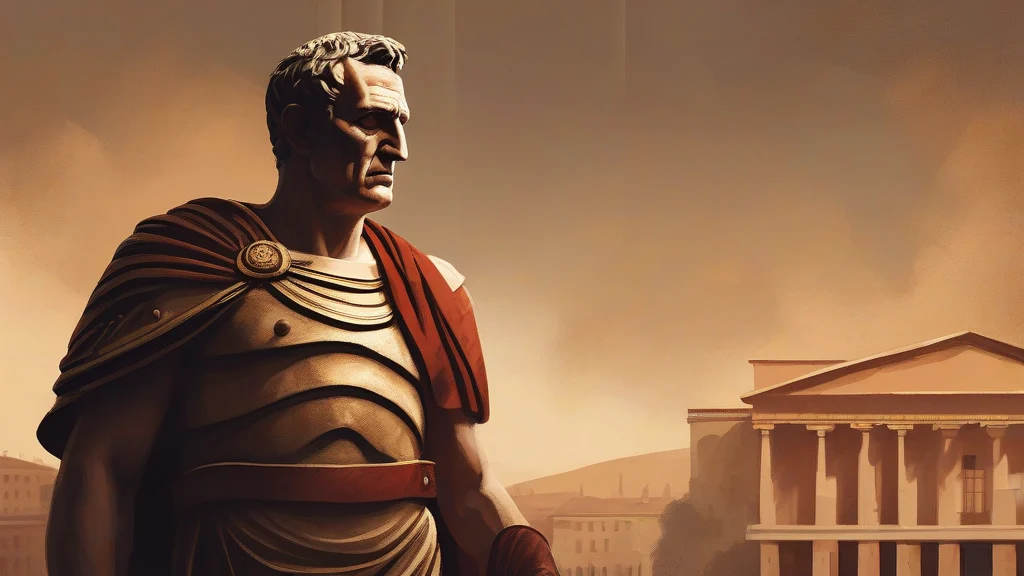
What does caesar mean?
A caesar is a Roman emperor, originally the title borne by the rulers of Rome following Julius Caesar, whose family name it was. Over time the word broadened beyond its historical sense: because Julius Caesar's successors adopted his name as a imperial title, 'caesar' came to stand for any emperor of Rome, and figuratively for any ruler who holds absolute, unaccountable power — a modern CEO or autocrat might be described as acting 'like a caesar.' The word's influence extends across languages: German 'Kaiser' and Russian 'Tsar' are both direct descendants of the name Caesar, making it one of the most successful surnames in history. In contemporary English it survives not only in political metaphor but also in fixed phrases like 'Caesar salad' and 'Caesar cipher,' each named for associations with the man or the title. Used figuratively, 'caesar' carries a distinctly negative connotation of tyranny and overreach.
A Roman emperor; by extension, any ruler wielding absolute or tyrannical power.
"The revolutionaries had grown weary of ruling themselves under a caesar."
Usually capitalized when denoting the Roman title or a specific emperor; frequently lowercase in figurative uses describing modern autocrats.
Used attributively in established phrases naming things associated with Julius Caesar or the imperial title, such as the Caesar salad and the Caesar cipher.
"She ordered a chicken caesar salad for lunch."
Regular plural; used when speaking of multiple Roman emperors or multiple figurative autocrats.
"The empire produced many caesars, some wise and some infamous."
The family name of one Roman man became so powerful that 'Kaiser' and 'Tsar' — the titles of German and Russian emperors for centuries — are both just 'Caesar' pronounced differently.
Reviewed by Deb Chak, Editor. AI-assisted content curated by RJS Tech Solutions LLP.
Etymology of caesar
The word derives from the cognomen ('Caesar') of the Julian family, most famously borne by Julius Caesar (100–44 BCE). After his death and the establishment of the empire, his adopted heir Augustus and subsequent Roman emperors took 'Caesar' as a title, cementing its meaning as 'emperor.' The term passed into other languages as an imperial designation: German 'Kaiser' and Russian 'Tsar' both descend directly from 'Caesar,' transmitted through Latin and Byzantine Greek respectively.
Related word forms
How caesar is actually used
'Caesar' is usually capitalized when referring to a specific historical figure or the title itself, and often lowercased when used figuratively for a domineering modern leader. The figurative use carries a connotation of authoritarianism and is typically somewhat literary or rhetorical.
Easily confused with caesar
A 'seizure' is a sudden attack or act of seizing (as in an epileptic seizure), while a 'caesar' is a Roman emperor or absolute ruler — the words sound alike but share nothing in meaning.