What does capelin mean?
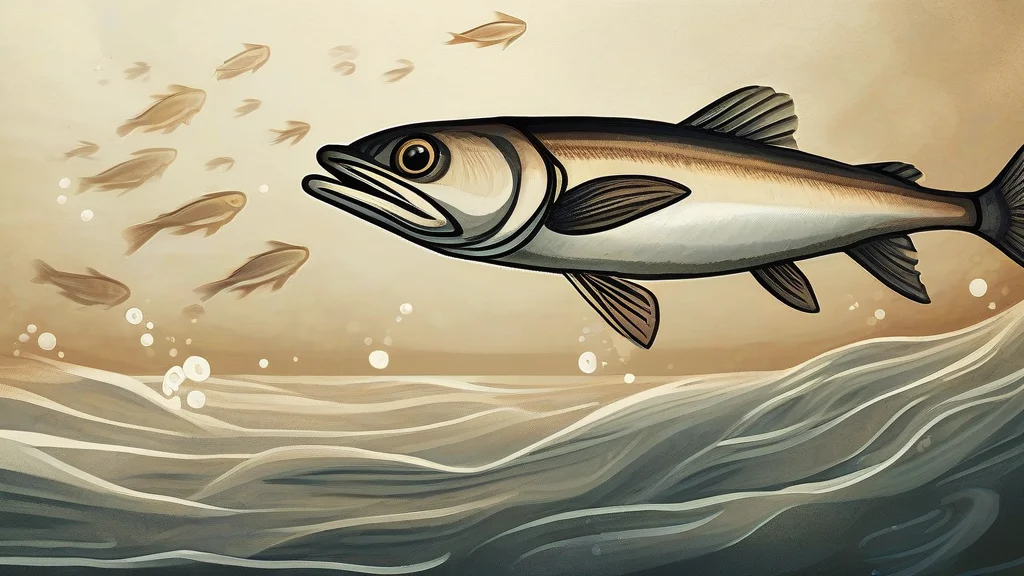
The capelin is a small, slender marine fish of the smelt family, scientifically known as Mallotus villosus, that lives in the cold waters of the North Atlantic and Arctic oceans. Rarely longer than about twenty centimetres, it is a classic example of a forage species: enormous schools of capelin sustain cod, seabirds, seals, and whales throughout the region. The fish is best known for its dramatic spawning behaviour, in which dense shoals swim into shallow water and even wash onto beaches — most famously on the coasts of Newfoundland and Labrador, an event known locally as the capelin roll. Commercially, capelin are harvested for bait, reduced to fishmeal and oil, salted or dried for food, and enjoyed grilled or fried, particularly in Iceland, Norway, and Japan. The word carries strong regional resonance in maritime Canada and Scandinavia, evoking seasonal abundance and traditional fishing culture.
nounA small marine fish (Mallotus villosus) of the smelt family, found in the North Atlantic and Arctic oceans, valued chiefly as bait, as food for larger fish, and as a food fish when dried or smoked.
- The small North Atlantic smelt-like fish Mallotus villosus, taken commercially for bait, animal feed, and human consumption.
- (Used attributively) Relating to or made from this fish, as in "capelin season" or "capelin oil."
"Each summer the capelin roll onto Newfoundland's beaches in vast silvery shoals to spawn."
"Cod follow the capelin shoals close inshore during the brief spawning season."
"The fishery's annual quota for capelin was set well below last year's catch."
In commercial and ecological writing the plural is frequently identical to the singular ("a shoal of capelin"), especially when referring to the fish collectively; "capelins" is acceptable when counting individual fish.
"The trawlers returned to port laden with capelin."
Every year millions of capelin deliberately beach themselves on Newfoundland's shores to spawn — an event locals simply call "the capelin roll."
Reviewed by Deb Chak, Editor. AI-assisted content curated by RJS Tech Solutions LLP.
Etymology of capelin
The word "capelin" entered English in the early seventeenth century, borrowed from French "capelan," which itself derives from Provençal and ultimately relates to the Late Latin "cappellanus," meaning chaplain — the diminutive fish was so named, perhaps whimsically, after the hooded clerical garment associated with that root (Latin "cappa," cloak or hood). The same Latin root gives English "chaplain," "capuchin," and, through later borrowing, "cappuccino." A variant spelling, "caplin," remains common in Newfoundland.
How capelin is actually used
Chiefly used in North Atlantic contexts — Canadian maritime provinces, Iceland, Norway — where it has commercial and cultural significance. The plural is commonly left unchanged ("a school of capelin"), though "capelins" also occurs. In everyday British and American usage outside these regions the word appears mostly in culinary, ecological, or fisheries writing.
Easily confused with capelin
"Capelan" is an older French-derived name for the same or closely related fish and survives mainly as a variant spelling, whereas "capelin" is the standard modern English form.