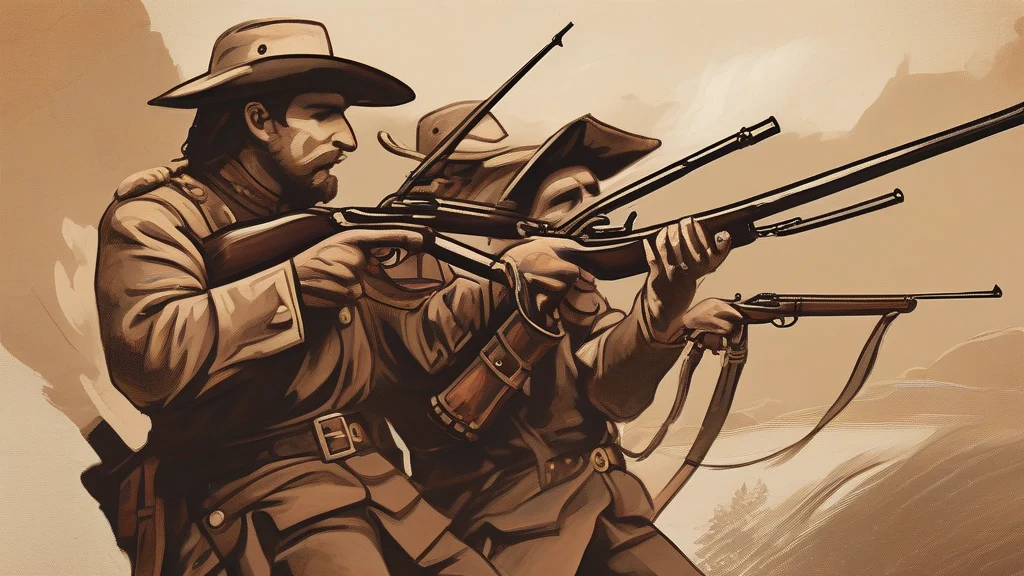
What does carabin mean?
A carabin is a short, lightweight musket—the weapon today more familiarly called a carbine—historically favored by cavalry and other mounted troops because its reduced length made it easier to handle on horseback than a full-size infantry musket. The word is now largely archaic, appearing mainly in historical writing, arms catalogs, and older dictionaries, where it functions as a variant spelling of "carbine." Despite its obscurity, it remains linguistically important as the direct ancestor of two living words: "carabineer," once denoting a soldier armed with such a gun, and "carabiner," the spring-loaded metal clip that modern climbers use to attach ropes and equipment. Encountering "carabin" therefore signals a text concerned with early firearms or military history, and understanding it illuminates how a single term can branch from battlefield weaponry into everyday sporting hardware over several centuries.
nounA carabin is a short light musket or carbine, historically carried by cavalry soldiers; it is now chiefly a rare or archaic variant spelling of "carbine".
- A short, light musket or carbine formerly used especially by cavalry (now usually spelled "carbine").
"The dragoon slung his carabin across his back before mounting."
"The museum displayed a seventeenth-century carabin alongside the cavalryman's pistols."
"Each trooper was issued a carabin, lighter than the infantry's full-length musket."
Standard pluralization; the plural is rare since the word itself is archaic.
"The armoury held racks of carabins awaiting issue to the new regiment."
Every climber clipping a carabiner is handling the modern descendant of a word that once named a soldier's short musket.
Reviewed by Deb Chak, Editor. AI-assisted content curated by RJS Tech Solutions LLP.
Etymology of carabin
The word entered English from French "carabine" in the sixteenth or seventeenth century, ultimately tracing back through Old French and possibly Italian origins associated with lightly armed skirmishers. From the same root come the French "carabine" and Italian "carabina," as well as "carabiniere," the name of Italy's military police corps. Over time English usage standardized on "carbine," leaving "carabin" as a rarer variant, while the extended form "carabiner" gave the old weapon-word an unexpected afterlife in mountaineering.
Related word forms
How carabin is actually used
"Carabin" is now rare; readers will almost always encounter "carbine" for the weapon and "carabiner" for the climbing clip. It survives mainly in historical texts, dictionaries, and discussions of arms terminology, so it carries a distinctly antiquarian register.
Easily confused with carabin
A carabiner is a modern metal clip used in climbing, whereas a carabin is an old short firearm; they share an etymology but are entirely different objects.
"Carbine" is the standard modern term for the short rifle; "carabin" is simply a historical or alternate spelling of essentially the same weapon.