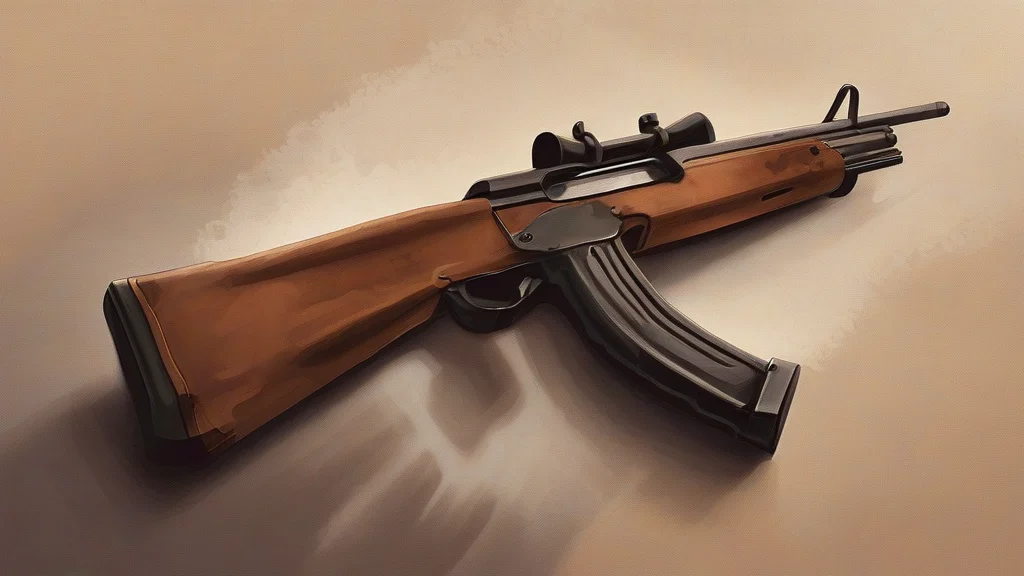
What does carabine mean?
A carabine is a light firearm with a relatively short barrel, designed to be easily handled on horseback or in confined conditions. It is best understood as a variant spelling of 'carbine', which is the standard English form today; 'carabine' appears mainly in historical writing and in borrowings directly from French. Such weapons were favoured by cavalrymen, dragoons, and other mounted troops from roughly the seventeenth century onward, because their reduced length made them far easier to carry and use while riding than a full-length musket. The word entered European languages via the French 'carabine', ultimately linked to 'carabin', a term for the lightly armed soldiers who carried these guns — the same root that gives us the Italian 'carabinieri' and, by way of German, the climber's 'carabiner'. Though obsolete as everyday vocabulary, 'carabine' survives in military history, arms collecting, and antiquarian prose.
nounA carabine is a lightweight, short-barrelled firearm; it is chiefly a variant form of the word 'carbine'.
- A light, short-barrelled shoulder gun, typically carried by cavalry soldiers (a variant of the more common term 'carbine').
"The cavalryman slung his carabine across his back before mounting."
"The museum's armoury displays a flintlock carabine used by light cavalry in the eighteenth century."
"Armed with little more than a carabine, the frontier scout ranged far ahead of the column."
Standard plural formation; rarely encountered outside historical texts.
"The regiment stacked its carabines outside the barracks."
'Carabiner' climbing clips get their name from the same old French word for this short soldier's gun — 'carabin', the musketeers who carried it.
Reviewed by Deb Chak, Editor. AI-assisted content curated by RJS Tech Solutions LLP.
Etymology of carabine
The word comes from the French 'carabine', derived from 'carabin', a term for an armed horseman or skirmisher, itself possibly influenced by 'escarboucle' (a carbuncle) or by older terms for arquebuses. It was borrowed into English in the seventeenth century alongside the weapon it named. The same root produced the Italian 'carabinieri' and, through German 'Karabinerhaken', the climbing 'carabiner'. In modern English usage the shorter, more direct form 'carbine' has largely displaced 'carabine'.
How carabine is actually used
'Carabine' is now rare in English, surviving mostly in older texts and as a borrowing from French; modern writers use 'carbine'. The related Italian-derived 'carabinieri' refers to Italy's national police force.
Easily confused with carabine
Both denote a short-barrelled firearm and are essentially variant spellings of the same word; 'carbine' is the standard modern form in English, while 'carabine' is an older or French-influenced spelling.
A carabiner is a metal loop with a spring-loaded gate used in climbing, whereas a carabine is a firearm — they share an etymological root but are entirely different objects.