
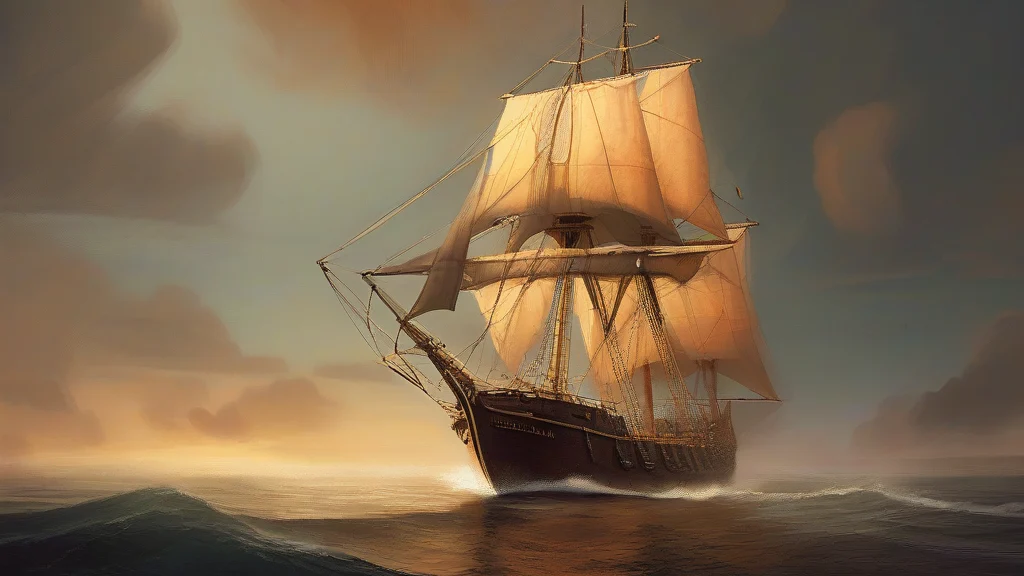
What does caravelle mean?
A caravelle is a historical sailing ship best known as a small, fast, and maneuverable vessel developed by the Portuguese during the 15th century. Its sails and compact hull made it well suited to long voyages, exploration, and commerce, and caravelles became closely associated with the European expansion into Africa, Asia, and the Americas. The word can also refer more broadly to certain light sailing vessels used in European and Mediterranean waters during the 17th century. In modern English, it is mainly encountered in historical writing, maritime studies, museum labels, and discussions of early exploration, while the spelling caravel is generally more common. Although often described by historians as a distinct type of vessel rather than simply a small galley, a caravelle is distinguished chiefly by its speed, sailing capacity, and ability to handle varied wind conditions. The term therefore evokes both practical seamanship and one of the defining technologies of the Age of Sail.
nounA small, fast, highly maneuverable sailing ship of the 15th and 16th centuries, developed by the Portuguese for exploration and trade. The term can also denote certain larger, light sailing vessels of the 17th century.
- A small, fast sailing ship of the 15th and 16th centuries, developed by the Portuguese and usually equipped with lateen sails for speed and maneuverability.
- A light sailing vessel of the 17th century, particularly in European and Mediterranean maritime usage.
"The museum's replica of a 16th-century caravelle carries the lateen sails once used during Portugal's voyages of exploration."
"The caravelle was built for speed, allowing its crew to sail efficiently against prevailing winds."
"Several caravelles carried merchants and cargo between European and Mediterranean ports."
The plural is formed by adding -s to caravelle.
"Two caravelles departed together on their long voyage."
Caravelles were among the nimble ships that helped turn Portuguese exploration into a global maritime enterprise.
Reviewed by Deb Chak, Editor. AI-assisted content curated by RJS Tech Solutions LLP.
Where does caravelle come from?
English borrowed the word through Middle French caravelle, from Late Latin carabellus, a diminutive of Latin carabus. Latin carabus in turn came from Ancient Greek karabos, a term associated with a small boat or vessel. The same ancient root ultimately underlies cognates such as carabus, carabid, carabine, and karabiner.
Related word forms
How caravelle is actually used
Caravelle is chiefly a historical or literary term and is less common in modern English than caravel. It often carries associations with exploration, commerce, maritime skill, and the Age of Sail.
Easily confused with caravelle
Caravel is the more common modern English spelling, whereas caravelle is an alternative spelling especially associated with historical and European usage.