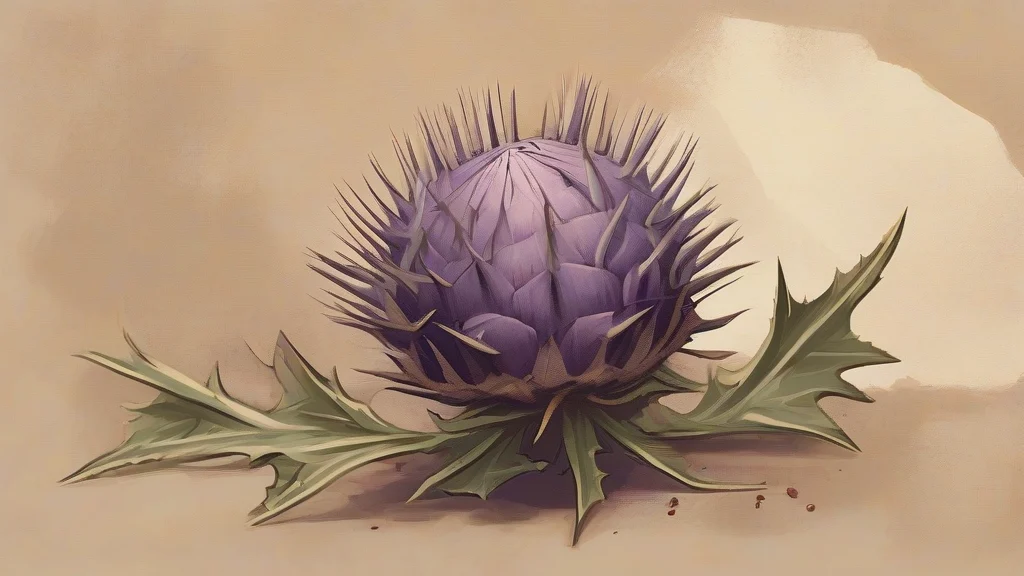
What does cardon mean?
Cardon is a noun denoting the cardoon — a large, silvery Mediterranean thistle (Cynara cardunculus) closely related to the globe artichoke. Unlike the artichoke, whose flower buds are eaten, the cardon is grown for its broad, fleshy leaf stalks, which are bitter and tough unless first blanched by excluding light, traditionally by banking up soil or wrapping the plant. The blanched stalks are then boiled, braised, or baked in gratins and are especially associated with southern European cookery, appearing in classic Provençal and Italian Christmas dishes. In modern English usage the standard spelling is 'cardoon', with 'cardon' serving as a variant closer to the original French form. The word surfaces mostly in cookbooks, seed catalogues, and garden writing, giving it a distinctly horticultural and gastronomic flavour rather than general currency in everyday conversation.
nounA large Mediterranean thistle (Cynara cardunculus) closely related to the globe artichoke, cultivated for its thick edible leaf stalks, which are typically blanched before cooking; it is more commonly spelled 'cardoon'.
- The cardoon (Cynara cardunculus), a Mediterranean thistle cultivated for its thick edible leaf stalks, which are usually blanched before cooking.
"The chef braised the blanched cardon stems in olive oil until they were tender."
"In Provence, cardon is traditionally served in a gratin at Christmas dinner."
"She grew cardon in the kitchen garden, banking soil around the stalks to blanch them for winter cooking."
Regular plural formation; used when referring to multiple plants, stalks, or prepared servings of the vegetable.
"The recipe calls for two large cardons, trimmed and cut into batons."
This spiky relative of the artichoke has been prized on Mediterranean tables since ancient times — but you have to bury its stalks to blanch them before they're fit to eat!
Reviewed by Deb Chak, Editor. AI-assisted content curated by RJS Tech Solutions LLP.
Etymology of cardon
Cardon comes to English through French, in which cardon denotes the same thistle. The French term derives from the Late Latin diminutive cardunculus, meaning 'little thistle', itself formed on Latin carduus, 'thistle'. This same Latin root underlies related words such as chard and card, which passed into English via Old French forms connected to thistly plants. English usage of the word dates back several centuries, though the spelling cardoon became dominant over time.
How cardon is actually used
The standard modern English spelling of this vegetable is 'cardoon'; 'cardon' is chiefly a historical or French-influenced variant. The word appears mainly in culinary and gardening contexts rather than everyday speech.
Easily confused with cardon
A 'carton' is a light cardboard or plastic container for food or goods, whereas a 'cardon' is an edible Mediterranean thistle plant.
'Cardoon' is the standard English spelling of the same vegetable; 'cardon' is a variant form, closer to the original French.