
What does cariama mean?
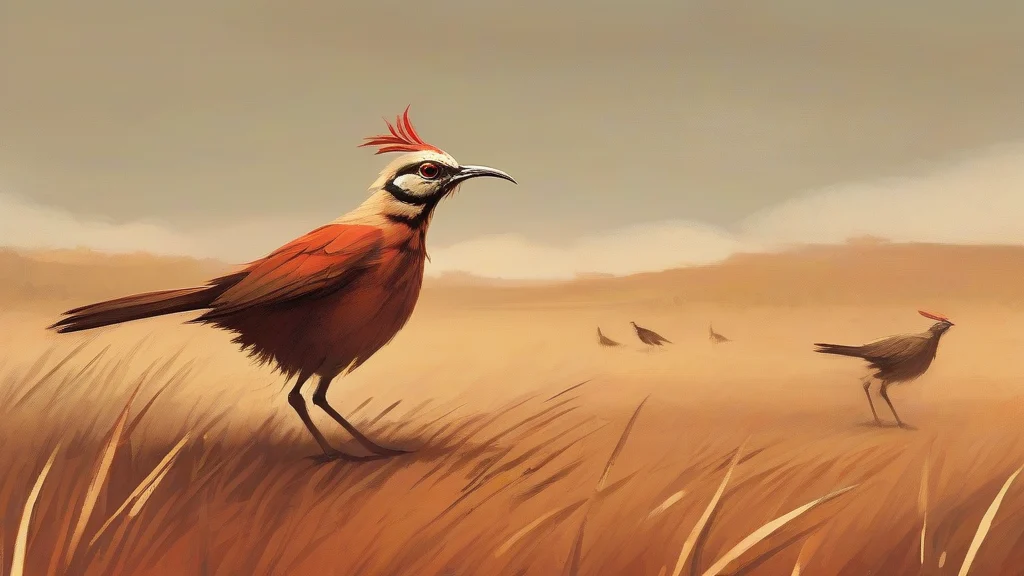
The cariama is a distinctive ground-dwelling bird native to the grasslands and scrublands of central and southern South America. Long-legged, long-necked, and crested, with a stout hooked bill, it spends nearly all of its time on foot, running swiftly to escape predators rather than taking wing — an adaptation that has made it one of the continent's most recognizable terrestrial birds. The best-known species, the red-legged or crested cariama (Cariama cristata), ranges widely across Brazil, Argentina, and neighboring countries; a related species, the black-legged cariama, inhabits drier western regions. Carnivorous by inclination, the cariama takes insects, small vertebrates, and even snakes, which it sometimes dispatches against rocks or hard ground. The word entered English via Portuguese from Tupi, an indigenous Brazilian language family. Though rarely encountered outside ornithology, the term appears in natural-history writing and field guides, where 'cariama' and 'seriema' are often used interchangeably for these remarkable running birds.
nounA long-legged, crested ground-dwelling bird of South American grasslands; specifically, either of two species constituting the family Cariamidae, especially the red-legged cariama (Cariama cristata), known for running rather than flying.
- Either of two South American birds of the family Cariamidae (the red-legged or crested cariama, Cariama cristata, and the black-legged cariama, Chunga burmeisteri), long-legged crested runners of open grasslands.
"The cariama stalks across the pampas on stilt-like legs, preferring to sprint from danger rather than take flight."
"A cariama crossed the dirt track in swift, loping strides, its crest standing erect."
"In captivity, keepers must be careful around the cariama, whose sharp beak it uses to subdue small prey."
The standard plural adds -s; the word itself functions as a common noun despite originating as a proper indigenous name.
"Several cariamas patrolled the edge of the woodland at dawn."
The cariama can outrun most predators on foot and will even drop snakes onto rocks to break them apart before swallowing.
Reviewed by Deb Chak, Editor. AI-assisted content curated by RJS Tech Solutions LLP.
Where does cariama come from?
The word 'cariama' comes through Portuguese from Tupi, the indigenous language family of Brazil, where it was the native name for this long-legged bird. It entered European scientific vocabulary during the early period of South American exploration and colonization, when naturalists recorded indigenous names for the region's fauna. It shares its Tupi origins with other Brazilian loanwords such as 'jaguar', 'tapioca', and 'toucan', which likewise passed into English through Portuguese.
How cariama is actually used
Used chiefly in ornithological contexts. The word may refer to the genus/species Cariama cristata specifically or to members of the family Cariamidae more broadly; 'seriema' is the more general common name for the family.
Easily confused with cariama
A chachalaca is a different Neotropical bird (an arboreal, chicken-like member of the family Cracidae), whereas the cariama is a long-legged, largely flightless runner of open grasslands.