What does cauliflower mean?
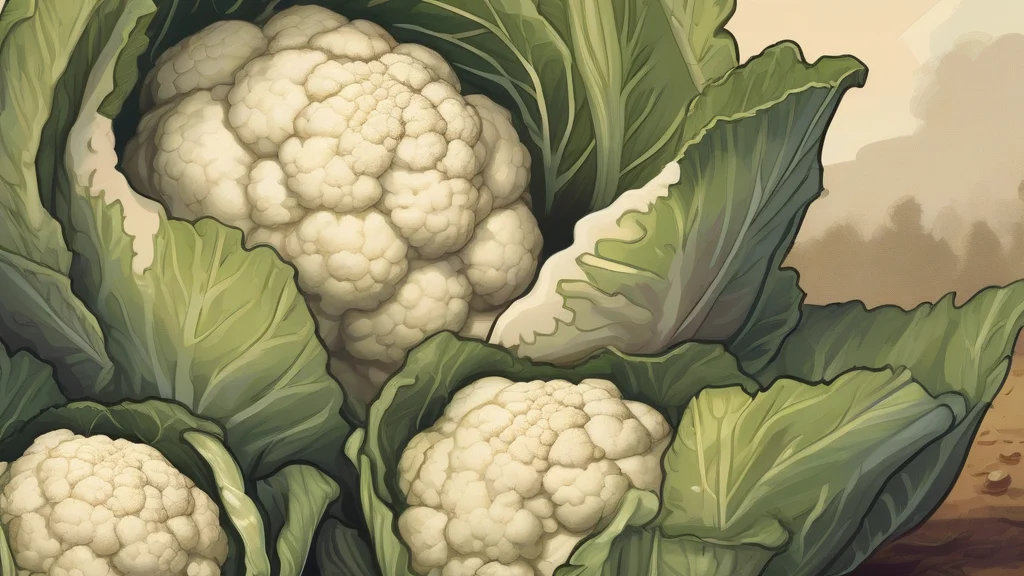
Cauliflower is a vegetable belonging to the species Brassica oleracea, the same species that gives us cabbage, broccoli, kale, and Brussels sprouts. It is grown for its large, dense head — botanically called a curd — made up of thousands of tightly packed, undeveloped flower buds that are kept white by shielding them from sunlight. Mild and slightly nutty when cooked, cauliflower has become a staple of modern cooking: it is roasted whole, puréed into soups, riced as a low-carbohydrate grain substitute, and even formed into pizza crusts. The word entered English in the late sixteenth century, adapted from Italian cavoli fiori, meaning 'cabbage flowers'. Beyond the kitchen, the phrase 'cauliflower ear' refers to the swollen, deformed ear caused by repeated injury, familiar from contact sports. Versatile, nutritious, and visually striking, cauliflower is both a humble side dish and a fashionable centrepiece.
nounA variety of cabbage (Brassica oleracea) cultivated for its dense, edible white head of undeveloped flower buds, eaten as a vegetable. Also refers to the head itself when used as food.
- The plant Brassica oleracea var. botrytis, grown for its compact white head.
- The edible head (curd) of this plant, cooked and eaten as a vegetable.
"She roasted the cauliflower with olive oil and cumin until the florets turned golden brown."
"Mash the steamed cauliflower with butter and garlic for a low-carb alternative to mashed potatoes."
"The farmers' market had beautiful heads of cauliflower, their curds tight and snowy white."
Standard plural. When referring to the vegetable as food rather than individual heads, the uncountable singular 'cauliflower' is preferred.
"We bought two cauliflowers at the market this morning."
Cauliflower is literally an unopened bouquet of flowers — every white 'head' is thousands of immature flower buds frozen in time before they can bloom.
Reviewed by Deb Chak, Editor. AI-assisted content curated by RJS Tech Solutions LLP.
Etymology of cauliflower
Cauliflower derives from the Italian cavoli fiori, meaning 'cabbage flowers', which itself traces back to Latin caulis ('stalk, cabbage') and flōs ('flower'). The word was borrowed into English in the late sixteenth century, initially appearing in forms such as 'cole-flory' and 'colliflour' before settling on its current spelling. Its Latin root caulis also gives English the words cole (as in colewort), collard, and coleslaw, making cauliflower a close linguistic cousin of many other brassica terms.
Related word forms
How cauliflower is actually used
A common noun in everyday culinary contexts. In British English, 'cauliflower cheese' is a classic comfort dish; in American usage it more often appears roasted, riced, or as a pizza-crust substitute. The plural is simply 'cauliflowers', though the mass noun sense ('some cauliflower') is also standard.
Easily confused with cauliflower
An obsolete or dialectal spelling of cauliflower; the modern standard form is always spelled with -au-.