What does cerrado mean?
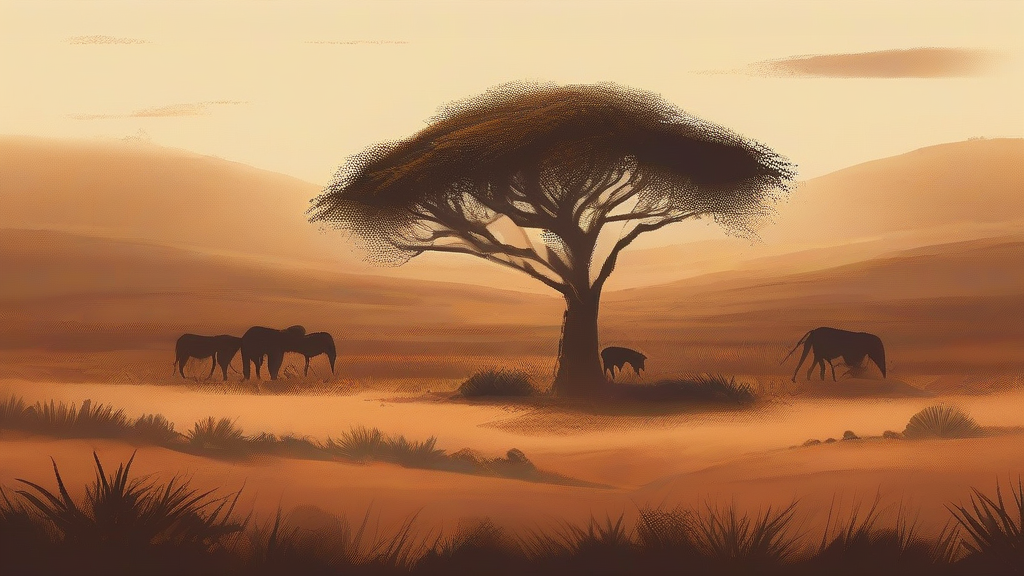
The cerrado is an immense tropical savanna that stretches across much of central Brazil, covering roughly a fifth of the country. Unlike a rainforest, its landscape is defined by grassland dotted with hardy, twisted trees and shrubs whose roots plunge deep into nutrient-poor soil — adaptations to seasonal drought and frequent natural fire. The name comes from the Portuguese word for 'closed', reflecting early settlers' sense that the dense, tangled vegetation was impenetrable. Biologically, the cerrado is extraordinary: it hosts thousands of endemic plant species alongside maned wolves, giant anteaters, and armadillos, leading scientists to call it the world's most diverse tropical savanna. Yet it is also under severe pressure, with large areas cleared each year for soy cultivation and cattle ranching. In English, 'cerrado' appears chiefly in ecology, geography, and environmental journalism, usually capitalized as a proper regional name.
nounA vast tropical savanna ecoregion of central Brazil, characterized by scattered drought-resistant trees and shrubs over grassland. Also used more generally to refer to this type of vegetation formation.
- The tropical savanna ecoregion of central Brazil, marked by dense-rooted, fire-adapted trees and shrubs.
- A similar vegetation formation resembling this Brazilian savanna.
"The cerrado covers roughly a fifth of Brazil's land area and is one of the world's most biodiverse savannas."
"Much of the cerrado has been converted to farmland over the past half-century."
"Ecologists warn that less than three percent of the original cerrado enjoys legal protection."
Rarely pluralized; the word usually functions as a mass or proper noun for the single Brazilian region. A plural may appear when discussing multiple analogous savanna formations elsewhere.
"Similar cerrados occur across parts of Bolivia and Paraguay."
The cerrado is often called Brazil's 'other rainforest' — it stores vast amounts of carbon in its deep roots underground rather than in towering trees above.
Reviewed by Deb Chak, Editor. AI-assisted content curated by RJS Tech Solutions LLP.
Etymology of cerrado
Cerrado comes directly from the Portuguese adjective 'cerrado', meaning 'closed' or 'shut', derived from the verb 'cerrar' ('to close'), which traces back through Latin 'serare' or 'serrare' ('to bolt, shut'). Early Portuguese colonists applied the term to the region's seemingly impassable, densely thicketed vegetation. It entered English usage in the twentieth century through ecological and geographical literature on South America. The same Latin root gives us the rare English word 'serried', meaning pressed closely together, which echoes the same idea of compact density found in the original Portuguese.
How cerrado is actually used
Usually capitalized when referring specifically to the Brazilian ecoregion; lowercase when describing the general vegetation type. The word is a direct borrowing from Portuguese and remains most at home in scientific, environmental, and journalistic writing.
Easily confused with cerrado
'Savanna' is the general term for grassland with scattered trees worldwide, while 'cerrado' specifically names the Brazilian savanna region and its distinctive vegetation type.