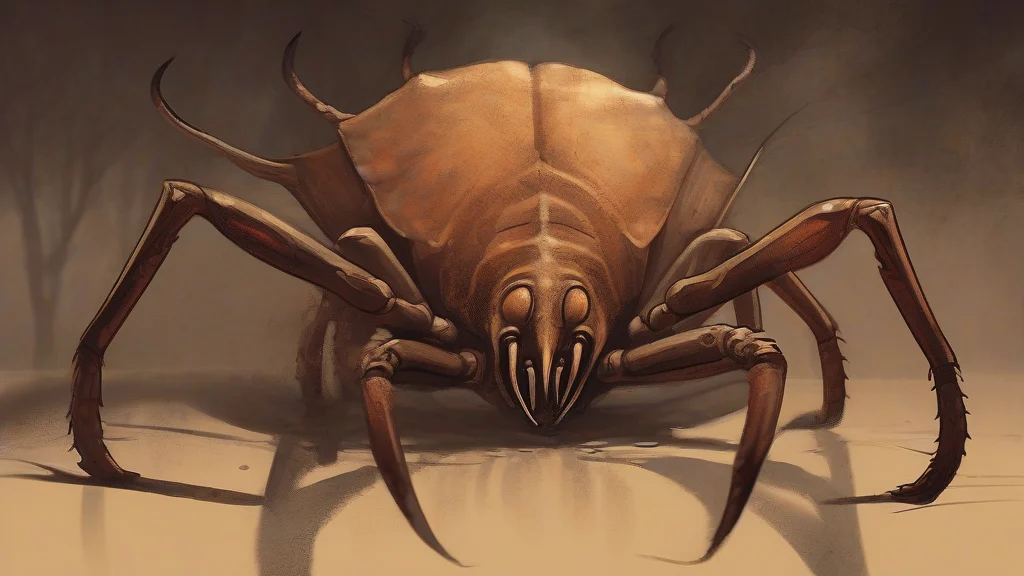
What does chelicera mean?
A chelicera is one of a pair of specialized appendages positioned just in front of the mouth in arachnids — spiders, scorpions, ticks, and mites — as well as other members of the group known as chelicerates, including horseshoe crabs. In most arachnids the chelicerae serve as pincers for gripping and tearing food, but in spiders they are dramatically modified into fangs, often hollow, through which venom is injected into prey. The word comes from Greek roots meaning 'claw' and 'horn,' reflecting these structures' pointed, claw-like form. Because chelicerae are a defining anatomical feature distinguishing chelicerates from insects and other mandibulate arthropods, the term carries real taxonomic weight: biologists use it to classify and compare groups across hundreds of millions of years of evolution. Almost entirely confined to scientific literature, it appears overwhelmingly in its plural form, chelicerae, and is essential vocabulary for anyone studying arthropod anatomy.
nounEither of a pair of appendages located just in front of the mouth in arachnids and other chelicerates, typically modified into pincers for grasping prey or, in spiders, into fangs used to inject venom.
- One of the paired, pre-oral appendages of arachnids and other chelicerates, modified variously as pincers, fangs, or sensory structures.
"The spider subdued its prey by driving its hollow chelicerae deep into the insect's body."
"The tarantula's chelicerae move downward like a pair of folding knives as it strikes."
"Under the microscope, each chelicera was clearly segmented, ending in a curved, venomous fang."
The standard plural follows the Latin-style -a/-ae pattern; it is far more frequent than the singular because the appendages naturally occur as a pair.
"Spiders use their chelicerae not only to deliver venom but also to crush and manipulate prey."
Every spider's fang is actually a chelicera — the same claw-tipped limb that scorpions and horseshoe crabs use simply to pinch.
Reviewed by Deb Chak, Editor. AI-assisted content curated by RJS Tech Solutions LLP.
Etymology of chelicera
The word 'chelicera' derives from the Greek 'chele' (χηλή), meaning claw or talon, combined with 'keras' (κέρας), meaning horn. It entered scientific Latin in the nineteenth century as zoologists formalized the anatomy of arthropods, and it gives its name to the entire subphylum Chelicerata, whose members possess these claw-bearing appendages. Related terms sharing the same Greek root include 'chela' (the pincer of a crustacean) and the chemistry term 'chelate', which describes molecules that grip metal ions like a claw.
Related word forms
How chelicera is actually used
A technical term used almost exclusively in zoology, entomology, and paleontology; it rarely appears outside scientific writing. It is nearly always discussed in the plural (chelicerae), since the appendages occur as a pair. The adjective 'cheliceral' describes features relating to these appendages.
Easily confused with chelicera
Mandibles are jaw appendages found in insects and other mandibulates, whereas chelicerae are the pincer-like or fang-like appendages found instead in arachnids and their relatives.
Pedipalps are a second, separate pair of appendages behind the chelicerae in arachnids, often used for sensing or handling food rather than biting.