
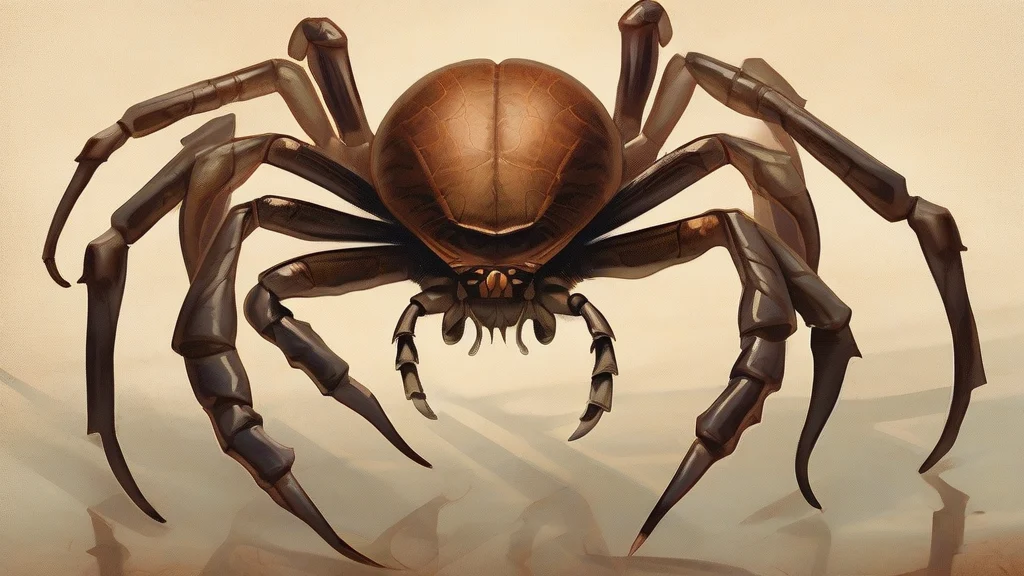
What does chelicerate mean?
Chelicerate is a technical zoological term for any member of the arthropod clade Chelicerata. This diverse group includes arachnids such as spiders, scorpions, mites, and ticks, as well as horseshoe crabs and sea spiders. Its members share a characteristic body plan in which the first pair of appendages is modified into mouthparts called chelicerae; they also lack antennae. The word is especially useful in discussions of animal evolution, comparative anatomy, and paleontology because early chelicerate fossils document major changes in arthropod development. Although “chelicerate” is sometimes used informally as though it were interchangeable with “arachnid,” the broader classification is important. In ordinary writing, the term has little use outside scientific contexts. As an adjective, it describes features, structures, or organisms associated with this group, as in “chelicerate body plan.”
Any arthropod belonging to the clade Chelicerata, including arachnids, horseshoe crabs, and sea spiders.
"The chelicerate preserved its paired mouthparts and several articulated legs."
Used chiefly in zoology, paleontology, and comparative anatomy.
Relating to or characteristic of chelicerates or the clade Chelicerata.
"The researchers compared chelicerate appendages with those of modern arachnids."
This attributive use is less common than the noun and is mainly found in scientific writing.
The standard plural is “chelicerates,” used for multiple members of the group.
"Several chelicerates occur in the same Cambrian fossil deposit."
No antennae needed: chelicerates have a specialized first pair of limbs transformed into mouthparts called chelicerae.
Reviewed by Deb Chak, Editor. AI-assisted content curated by RJS Tech Solutions LLP.
Where does chelicerate come from?
The word comes through the Latinized zoological name Chelicerata, built from Greek chēlē, meaning “claw,” and keras, meaning “horn.” The earlier term chelicera refers to the paired claw-like mouthparts from which the group name was developed. Modern taxonomic usage treats Chelicerata as a major arthropod group with related forms in the chelicera, chela, and chelate families of words.
Related word forms
How chelicerate is actually used
This is primarily a technical zoological and paleontological term, used in biology, taxonomy, and evolutionary studies but rarely in general prose. It is broader than “arachnid,” since arachnids are only one major group within the chelicerates.
Easily confused with chelicerate
A chelicera is one of the paired mouthparts of a chelicerate, whereas a chelicerate is the animal itself.