What does chelicerae mean?
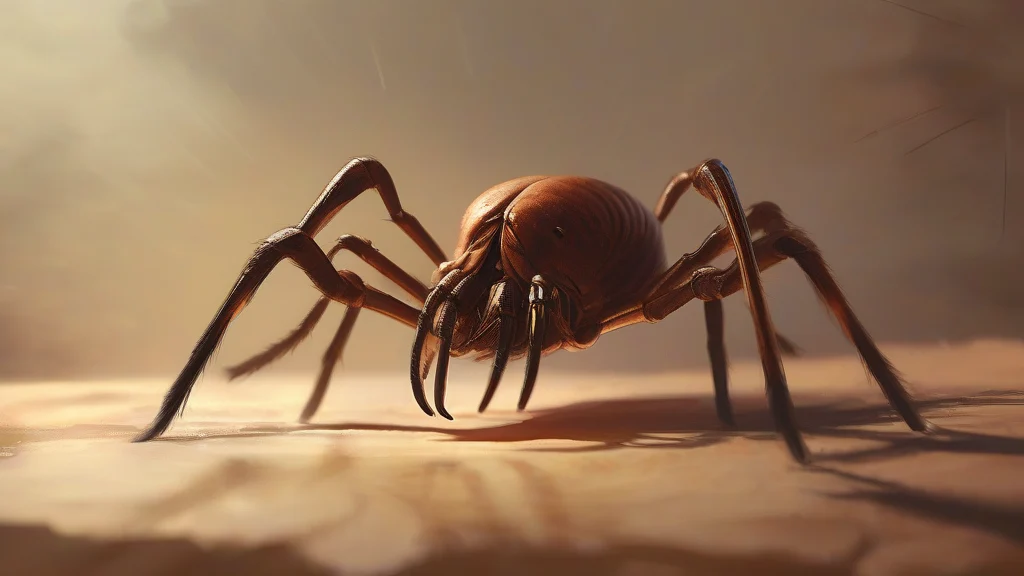
Chelicerae are the first pair of specialized appendages found on arachnids — spiders, scorpions, ticks, and mites — and on other members of the arthropod group known as chelicerates. Positioned just in front of the mouth, they function as pincers or cutting tools used to grasp and process food. In spiders, each chelicera bears a hollow fang connected to a venom gland, making these structures the delivery system for a spider's bite. The term derives from Greek roots meaning 'claw' and 'horn', reflecting the claw-like shape of these organs. Because chelicerae are anatomically distinct from insect mandibles and from the pedipalps behind them, the word is essential vocabulary in zoology and comparative anatomy. Though strictly scientific in register, it appears frequently in popular nature writing about spiders and other arachnids, where precision about how these animals feed and defend themselves matters.
nounThe paired pincer-like appendages found in arachnids (such as spiders and scorpions) and related arthropods, attached to the front of the body near the mouth; in spiders they bear the fangs through which venom is injected.
- The first pair of appendages on arachnids and other chelicerate arthropods, used for grasping, cutting, or injecting venom; in spiders these bear the fangs.
"The spider seized its prey with its chelicerae before delivering a venomous bite."
"Under the microscope, the tick's barbed chelicerae were clearly adapted for slicing into skin."
"Scorpions lack true jaws; instead they macerate their food using the chelicerae at the front of their bodies."
'Chelicerae' is itself the standard plural of 'chelicera'; it follows Latin-style pluralization and is the form normally used, since the structures occur in pairs.
"Each of the spider's chelicerae terminates in a movable fang."
A spider's fangs aren't its teeth — they're hollow-tipped extensions of a pair of limbs called chelicerae, making them modified legs you'd rather not be bitten by.
Reviewed by Deb Chak, Editor. AI-assisted content curated by RJS Tech Solutions LLP.
Etymology of chelicerae
The word 'chelicera' comes from New Latin, formed from the Greek elements 'chēlē' meaning 'claw' or 'talon' and 'keras' meaning 'horn'. It was adopted into scientific nomenclature during the nineteenth century as zoologists formalized the classification of arthropods, giving its name to the entire subgroup Chelicerata. Related terms from the same root include 'chela' (a pincer-like claw) and 'chelate' in both its zoological and chemical senses.
Related word forms
How chelicerae is actually used
A technical term used almost exclusively in zoology, entomology, and arachnology; rarely encountered outside scientific literature. It is always plural in form, being the plural of 'chelicera', and is pronounced with stress on the second syllable.
Easily confused with chelicerae
Pedipalps are a separate pair of appendages located behind the chelicerae and used mainly for sensing, handling food, or reproduction, whereas chelicerae are the foremost pair that typically bear the fangs.