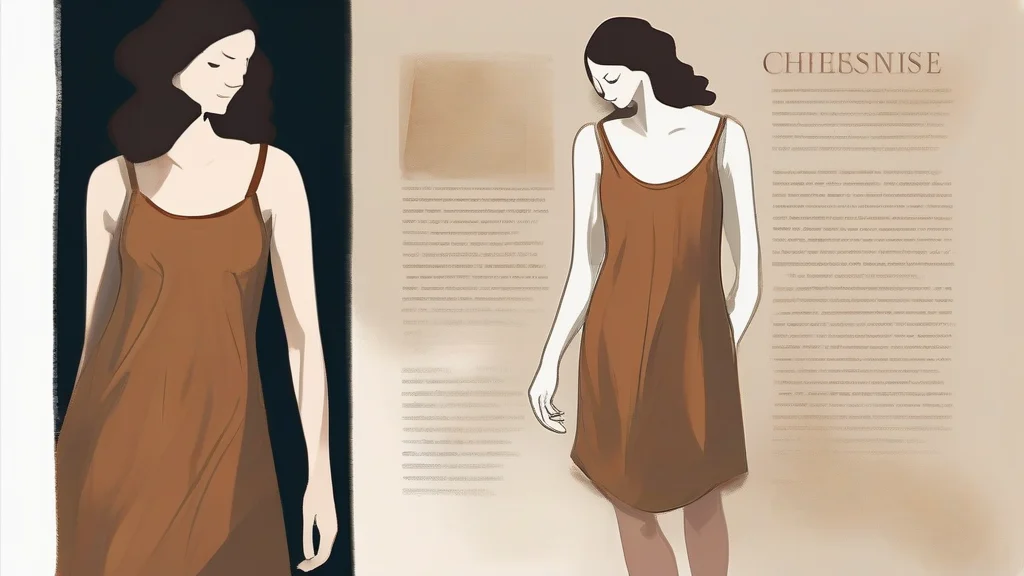
What does chemise mean?
A chemise is a loose, lightweight garment worn close to the body, most familiar today as a woman's slip-like undergarment or nightdress held up by slender straps. The word has deep historical roots: for centuries, from the medieval period onward, the chemise was the basic layer of clothing worn by everyone, regardless of class or gender, protecting the skin from rough outer garments and absorbing sweat so that outer clothes needed less frequent washing. Made of linen or cotton, it was among the simplest and most essential items in any wardrobe. In modern usage, the term has narrowed considerably, now suggesting something feminine, soft, and often luxurious — silk or lace chemises are sold as lingerie or sleepwear. The word entered English from French, ultimately deriving from the Latin camisia, meaning shirt or nightclothes, which makes it a distant relative of words like camisole.
nounA chemise is a loose-fitting, straight-cut undergarment or nightgown worn by women, typically with thin straps and reaching the thigh or knee. Historically, it also referred to a simple smock or shift worn next to the skin by both men and women.
- A woman's loose-fitting undergarment or nightgown, usually with thin straps.
- (Historical) A simple shift or smock worn as an undergarment by either sex.
"She slipped on a silk chemise before putting on her dress."
"The bride chose a delicate lace chemise for her wedding trousseau."
"Medieval peasants wore a plain linen chemise beneath their outer garments."
Standard English pluralization applies; pronounced identically to the singular apart from the final /z/ sound.
"The boutique stocked chemises in ivory, black, and blush."
The word 'chemise' comes from the Latin 'camisia', meaning shirt — making it a linguistic cousin of 'camisole'!
Reviewed by Deb Chak, Editor. AI-assisted content curated by RJS Tech Solutions LLP.
Etymology of chemise
Chemise entered English from French in the medieval period, when it denoted the plain linen shift worn beneath outer clothing. The French word derives from Late Latin camisia, meaning a shirt or garment worn next to the skin. This same root gave rise to related terms such as camisole and the Spanish camisa, all pointing to the garment's fundamental role as the layer closest to the body.
How chemise is actually used
The word carries connotations of delicacy and intimacy in modern usage. In historical contexts it refers to basic functional underwear worn by all social classes.
Easily confused with chemise
A chimera is an illusionary or impossible idea, whereas a chemise is a piece of clothing.