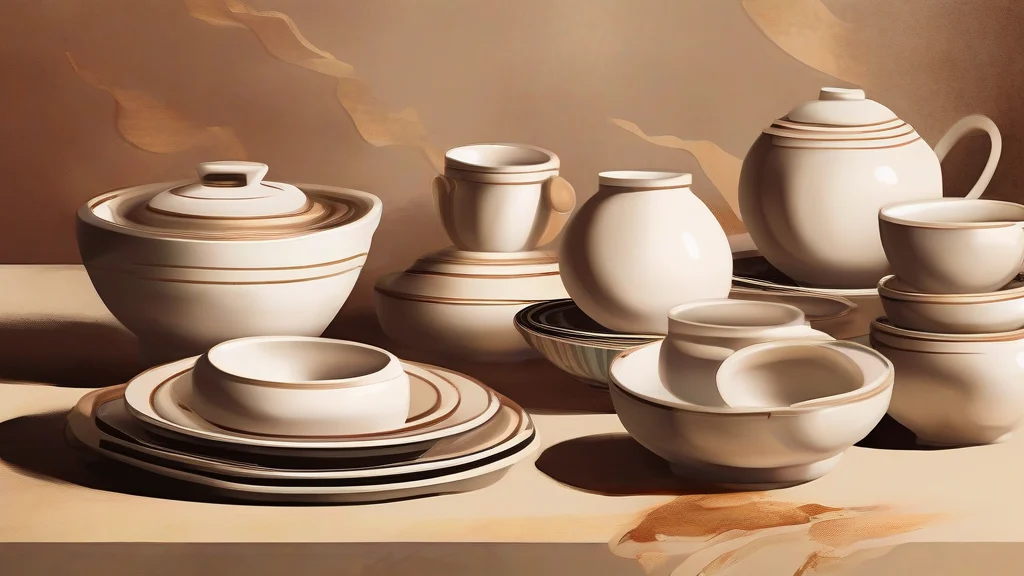
What does chinaware mean?
Chinaware refers to tableware—plates, bowls, cups, saucers, and serving pieces—made from china, meaning porcelain or a closely similar fine ceramic. The word combines "china," which English adopted because the world's finest porcelain was long exported from China, with the old Germanic word "ware," meaning manufactured goods. In practice, chinaware connotes something finer than everyday crockery: pieces chosen with care, displayed in cabinets, brought out for holidays, passed down as heirlooms, or collected by enthusiasts of specific makers and patterns. It is an uncountable noun, used slightly more formally than casual alternatives like "dishes"; British speakers often prefer "crockery," and American speakers commonly say "china" alone. The word appears most often in retail, interior design, antiques, and auction contexts, where distinguishing delicate ceramic tableware from metal, glass, or wooden ware matters.
nounChinaware is plates, bowls, cups, and other tableware made of china (porcelain or similar ceramic material), especially fine pieces used for serving food.
- Tableware — plates, cups, saucers, and serving dishes — made of china (porcelain or a comparable ceramic).
"She carefully unpacked the wedding chinaware and arranged it in the cabinet."
"The antique shop displayed rows of hand-painted chinaware behind glass."
"For the holiday dinner, my grandmother brought out the good chinaware that had been in the family for generations."
Chinaware is ordinarily uncountable, like "furniture" or "equipment." To count pieces, use "pieces of chinaware" or "sets of chinaware" rather than a plural form.
"She inherited several sets of chinaware from her aunt."
We call it "chinaware" because the finest porcelain originally came from one place: China, whose potters kept the secret of true porcelain for centuries before Europe cracked the recipe in the early 1700s.
Reviewed by Deb Chak, Editor. AI-assisted content curated by RJS Tech Solutions LLP.
Etymology of chinaware
The compound joins "china," a term English adopted in the 16th century for porcelain because such ceramics were imported from China, with "ware," an ancient Germanic word for manufactured goods that also yields "earthenware," "stoneware," and "hardware." The element "China" itself derives from Persian names for the country, ultimately traced to the Qin dynasty. "Chinaware" arose as a way to specify goods made of this material, paralleling other "-ware" compounds, and has been in use since at least the 17th century.
How chinaware is actually used
"Chinaware" is a mass (uncountable) noun in ordinary usage and leans slightly formal or commercial; in everyday British speech "crockery" is more common, while Americans often simply say "dishes" or "china." The word frequently appears in retail, collecting, and auction contexts.
Easily confused with chinaware
"China" refers to the country or, in lowercase "china," to porcelain collectively; "chinaware" specifically denotes items or vessels made of that porcelain.