What does cirque mean?
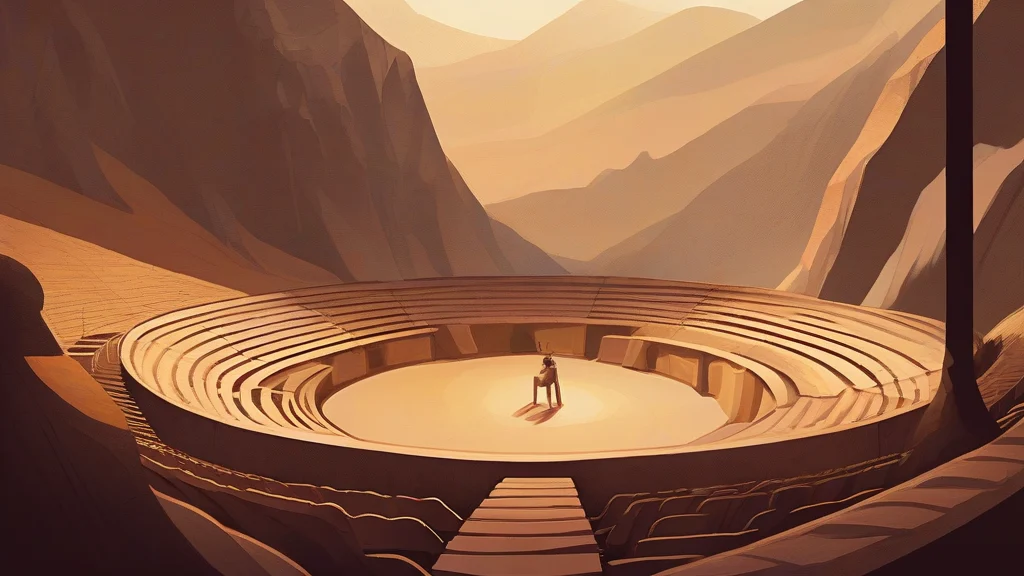
A cirque is a bowl-shaped, steep-walled hollow found at the head of a mountain valley, produced by the erosive action of glaciers. As ice accumulates and flows outward from a sheltered spot on a mountainside, it plucks and abrades the bedrock, excavating an armchair-like depression often floored by a small lake, or tarn, after the ice retreats. The word comes ultimately from the Latin 'circus', via French, reflecting the feature's rounded, arena-like form. Cirques are signature landforms of glaciated ranges such as the Alps, Rockies, and Himalayas, and they are standard terminology in geomorphology, mountaineering, and landscape description. British writers more often use the regional synonyms 'corrie' and 'cwm' for the same feature. For readers of nature writing, hiking guides, or earth-science texts, 'cirque' is a precise, evocative term worth knowing.
A steep-walled, bowl-shaped hollow at the head of a mountain valley, formed by the erosive action of a glacier.
"The alpine lake nestled in a cirque beneath the glacier's former path."
British equivalents are 'corrie' (Scots) and 'cwm' (Welsh).
(Historical) A circular arena or ring, such as that of a Roman circus, from the word's earlier French and Latin senses.
"The ancient text described the chariots racing around the vast cirque."
This sense is now largely obsolete in English.
Regular plural; used when referring to multiple such landforms across a region or range.
"The range is dotted with cirques left by Pleistocene glaciers."
That dramatic bowl at the top of many mountain valleys is literally a scar left behind by a glacier — and geographers borrowed its name from the Latin word for 'circus'.
Reviewed by Deb Chak, Editor. AI-assisted content curated by RJS Tech Solutions LLP.
Etymology of cirque
The word 'cirque' entered English in the early nineteenth century from French, where it denoted a ring-shaped enclosure, deriving ultimately from the Latin 'circus', meaning a ring or circle. It shares this root with 'circle', 'circuit', and the entertainment sense of 'circus'. Geologists adopted it to name the rounded, amphitheater-like basins carved by glaciers, a usage now dominant in English.
How cirque is actually used
In modern English, especially in North America, 'cirque' belongs chiefly to physical geography and mountaineering vocabulary and carries no figurative connotation. The equivalent British terms are 'corrie' (Scottish) and 'cwm' (Welsh); all three describe the same landform.
Easily confused with cirque
A circle is any round shape or closed curve, while a cirque is specifically a bowl-shaped landform eroded into mountainside rock by a glacier.
A circus is an entertainment spectacle or, historically, a Roman arena for chariot races, whereas a cirque is primarily a geological feature carved by glacial ice.