What does clarichord mean?
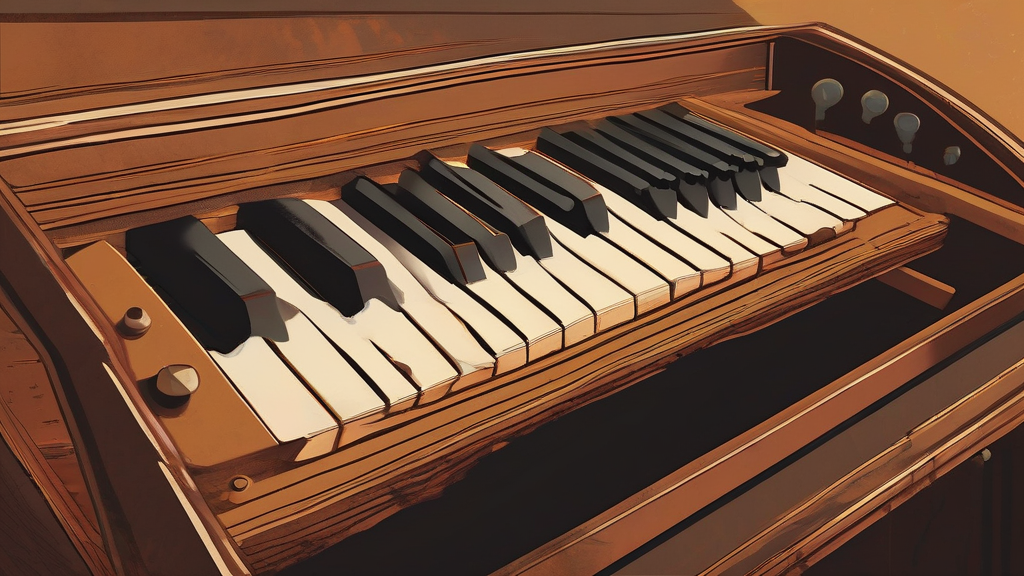
The clarichord is an early keyboard stringed instrument, best understood as a historical variant spelling of the clavichord. In such an instrument, pressing a key drives a small brass blade called a tangent against one or more strings, setting it vibrating at the desired pitch while simultaneously determining its sounding length. Unlike the harpsichord, which plucks its strings, the clavichord's striking action gave players unusual expressive control, including the ability to apply vibrato by varying pressure on the key — but its sound was so soft that it suited only intimate settings such as private rooms and practice. Because 'clarichord' survives mainly in older texts, catalogues, and period sources, modern readers encountering the term should recognise it as referring to this quiet, expressive ancestor of the piano rather than as a distinct instrument.
nounA clarichord is an early keyboard stringed instrument, now chiefly a variant or obsolete spelling of the clavichord, in which small metal tangents strike the strings when keys are pressed.
- An early keyboard stringed instrument in which metal tangents strike the strings; historically used as a spelling variant of clavichord.
"The museum's collection included a beautifully preserved clarichord from the seventeenth century."
"She practised her keyboard exercises quietly on a clarichord so as not to disturb the household."
"Early inventories of the royal music collection listed both harpsichords and a clarichord among the instruments."
The plural follows regular English noun formation and appears chiefly in historical inventories or discussions of collections of early instruments.
"Two clarichords were listed in the inventory of the court's musical instruments."
Despite its musical-sounding name, the clarichord isn't a clarinet relative — it's simply an old spelling of the clavichord, the quiet little keyboard that let players add vibrato to each note.
Reviewed by Deb Chak, Editor. AI-assisted content curated by RJS Tech Solutions LLP.
Etymology of clarichord
The clarichord shares its origin with the clavichord, whose name derives from Latin 'clavis', meaning key, combined with Greek-derived 'chorda', meaning string. The variant spelling reflects historical inconsistency in rendering the first element before the modern form became standard. It belongs to the same family of names for early stringed keyboard instruments as the clavichord, harpsichord, and related terms built on 'clavis' such as clavier.
How clarichord is actually used
'Clarichord' is rare in modern usage and functions mainly as a historical or variant form of 'clavichord'; contemporary writing about instruments almost always uses 'clavichord'. The word may appear in old catalogues, treatises, and period documents.
Easily confused with clarichord
The clavichord is the standard name of the tangent-struck keyboard instrument; 'clarichord' is largely a historical spelling variant of the same word rather than a different instrument.
A clarinet is a woodwind instrument played with a reed, whereas the clarichord is a stringed keyboard instrument.