What does clubmoss mean?
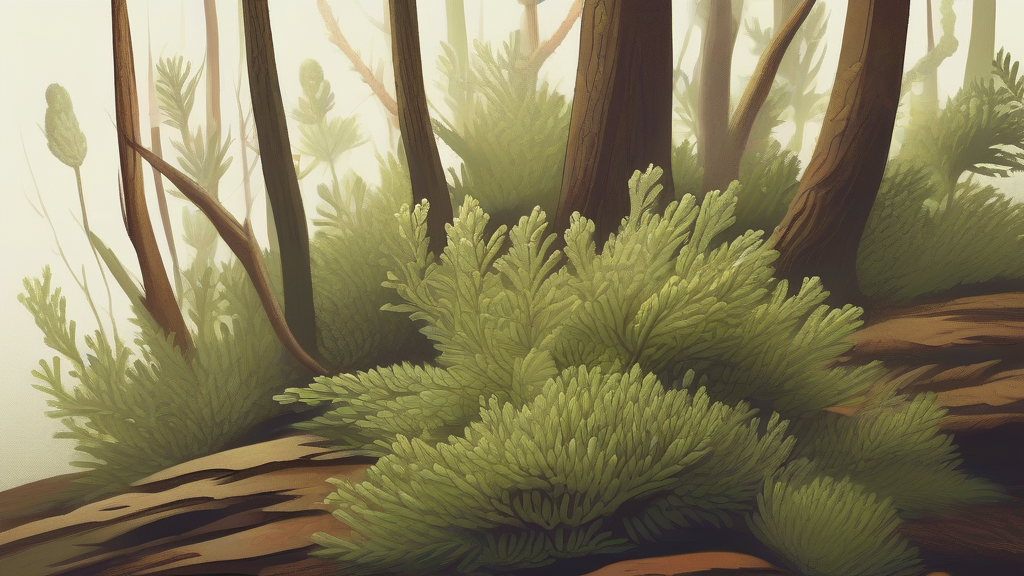
Clubmoss refers to any member of Lycopodiaceae, an ancient family of spore-bearing vascular plants found worldwide in moist woodlands, heaths, and alpine habitats. Despite the name, clubmosses are not true mosses: they possess vascular tissue for conducting water and nutrients, reproduce by means of spores rather than seeds, and bear distinctive upright, club-shaped cones called strobili. Most species are low-growing perennials with creeping stems and dense whorls of small, needle-like or scale-like leaves, giving some forms a resemblance to miniature conifers — hence folk names such as 'ground pine.' Clubmosses carry enormous evolutionary significance: their arborescent ancestors dominated Carboniferous swamp forests roughly 300 million years ago, and their compressed remains form much of the world's coal. Today they appear chiefly in botany, paleontology, horticulture, and traditional festive decoration, making the term useful to anyone reading about plant evolution or woodland ecology.
nounAny of a group of primitive, flowerless vascular plants of the family Lycopodiaceae, typically low-growing or creeping with small scale-like leaves and bearing spores in club-shaped cones.
- Any plant of the family Lycopodiaceae: a primitive spore-bearing vascular plant with small scale-like leaves and club-shaped cones.
"The forest floor was carpeted with clubmoss, its creeping stems dotted with upright spore cones."
"Hikers noticed the clubmoss creeping along the shaded banks of the stream, its tiny leaves overlapping like scales."
"In Carboniferous times, giant relatives of today's clubmoss grew into towering trees that later became coal seams."
Standard English plural, used when referring to multiple plants or several species within the family.
"Several different clubmosses grow along this trail, each identifiable by the shape of its cone."
Clubmosses are living fossils whose tree-sized ancestors built vast coal-forming forests over 300 million years ago — today's knee-high survivors were once giants.
Reviewed by Deb Chak, Editor. AI-assisted content curated by RJS Tech Solutions LLP.
Etymology of clubmoss
Clubmoss is a straightforward English compound formed from 'club' — referring to the plant's club-shaped spore cones (strobili) — plus 'moss,' reflecting the plant's moss-like ground-hugging habit. The compound arose in English botanical usage during the early modern period, when naturalists were classifying the world's flora. The misleading element is 'moss': the plant was so named from superficial resemblance, though botanists later established it as a vascular lycophyte unrelated to true bryophyte mosses.
Related word forms
How clubmoss is actually used
A botanical term used mainly in scientific, gardening, and naturalist contexts rather than everyday speech. The name is somewhat misleading, as clubmosses are not true mosses; they are vascular plants more closely allied to ferns. The plural 'clubmosses' is standard when referring to multiple individual plants.
Easily confused with clubmoss
True mosses are non-vascular bryophytes lacking true roots and vascular tissue, whereas clubmosses are vascular plants only distantly related to mosses despite their name.