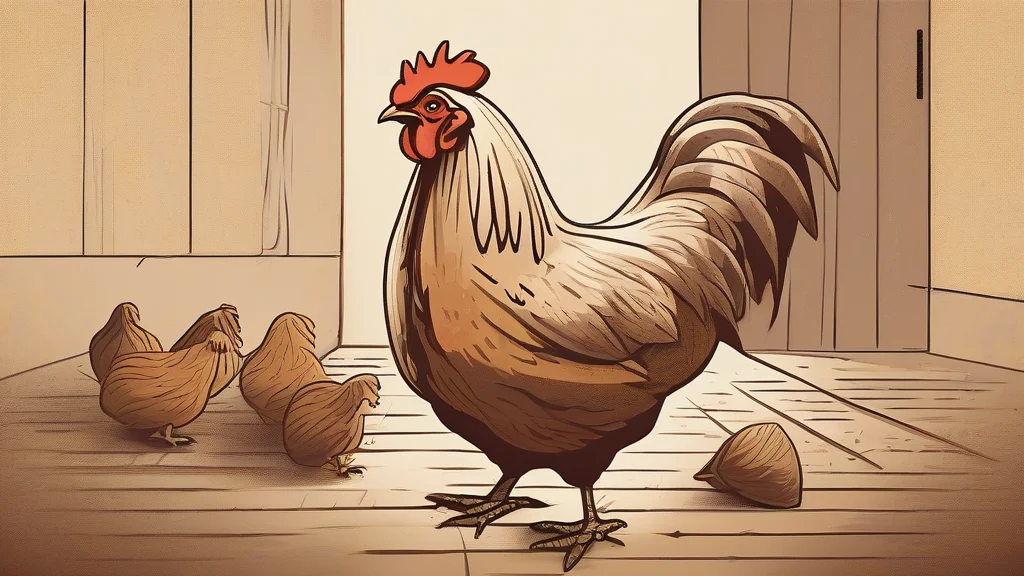
What does clucking mean?
Clucking is the present participle and gerund of 'cluck', an onomatopoeic English verb describing the short, low, guttural sound made chiefly by domestic hens. Hens cluck to communicate with their chicks, signal the laying of an egg, or express agitation, which makes the sound a familiar feature of farmyard life. By extension, people are said to be clucking when they make similar short murmuring sounds to convey mild disapproval, sympathy, or fussing concern — a mother might be described as clucking over a child's scraped knee, or colleagues as clucking disapprovingly at a decision. This figurative use lends the word a slightly patronizing, 'mother hen' connotation, suggesting well-meaning but sometimes tiresome solicitude. Because it is vivid and instantly recognizable, clucking appears frequently in both literal descriptions of poultry and figurative portrayals of human behavior.
Making the short, low guttural sound characteristic of a hen; figuratively, uttering short murmuring sounds expressing disapproval or fussing concern.
"The hens were clucking noisily when the fox appeared at the edge of the coop."
Most commonly used in progressive tenses.
The sound or act of clucking; a series of short, low guttural noises.
"We could hear the soft clucking of the hens from the kitchen window."
Rare; the uncountable singular 'clucking' is far more common when referring to the sound in general.
"The cluckings of the brood echoed through the barnyard."
English borrowed its word for a chicken's chatter straight from the sound itself — 'cluck' is pure onomatopoeia, one of the few words you can hear before you can spell.
Reviewed by Deb Chak, Editor. AI-assisted content curated by RJS Tech Solutions LLP.
Etymology of clucking
The verb 'cluck', from which 'clucking' derives, is onomatopoeic in origin, imitating the actual sound of a hen's call. It is attested in Middle English from around the fifteenth century in forms such as 'clokke'. Similar imitative forms exist in other Germanic languages, including Dutch 'klokken' and German 'glucken', reflecting a shared tendency to echo the hen's sound rather than descend from a single written ancestor.
Related word forms
How clucking is actually used
As a verb form, 'clucking' is most often used in progressive constructions ('was clucking') or as a gerund ('the clucking of hens'). The figurative sense carries a mildly critical or patronizing connotation, often implying fussy, maternal concern rather than serious anger.
Easily confused with clucking
A click is a short, sharp, non-vocal sound (as of a switch or camera), while a cluck is a low, guttural vocal sound made by a hen or by a person expressing mild disapproval.