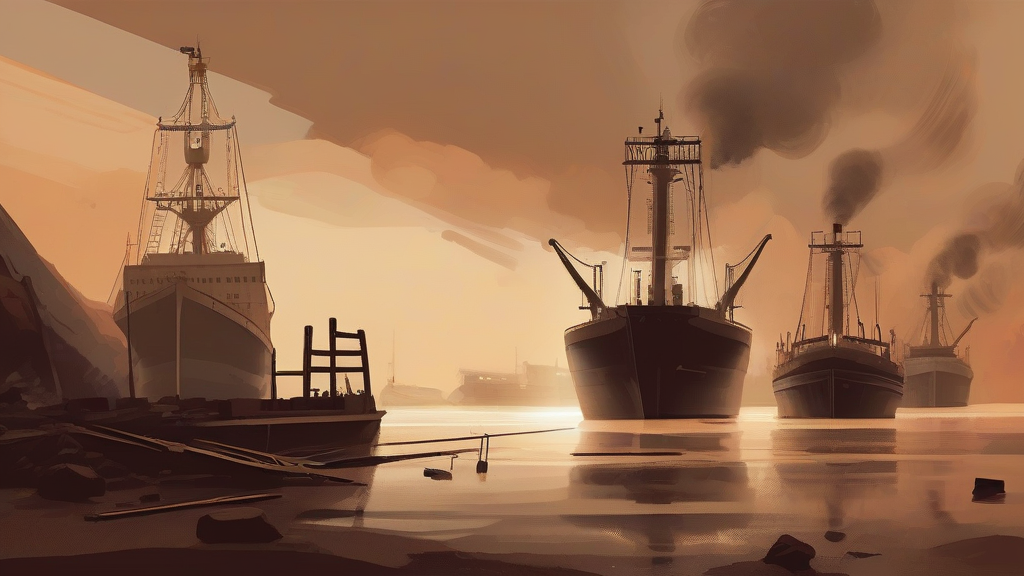
What does coaling mean?
Coaling refers to the act or process of supplying a ship, locomotive, or installation with coal. It was once a routine and critical maritime operation: in the age of steam, warships and merchant vessels burned enormous quantities of coal and could not cross oceans without stopping at designated coaling stations, where crews and dockworkers loaded bunkers by hand. These stations shaped geopolitics, driving nations to secure harbors and islands around the globe purely so their fleets could refuel. With the transition to oil-fired engines and diesel power during the twentieth century, coaling largely disappeared from everyday practice, and the word now survives mainly in naval history and heritage contexts, describing everything from the labor of loading coal to the infrastructure built around it. Though obsolete in daily use, it remains a vivid reminder of how thoroughly one fuel once governed global movement.
nounThe action or process of loading coal onto a vessel, vehicle, or facility, or of supplying something with coal; historically used especially of ships replenishing their coal bunkers at sea.
- The act of loading or supplying a ship, locomotive, or other vessel with coal (especially historical naval usage).
- The process of gathering or handling coal generally.
"The warship put in at Aden for coaling before continuing its voyage eastward."
"The steamer spent three days in port coaling before the transatlantic crossing."
"By the early twentieth century, coaling had become the bottleneck that dictated how far a battleship could sail from home."
Rarely pluralized; when it appears in the plural it usually refers to repeated or multiple coaling operations.
"The log recorded several coalings during the Pacific cruise."
Before oil took over, the world's navies dotted the oceans with 'coaling stations' — tiny islands like Midway mattered mostly because ships could stop there to shovel coal into their bunkers.
Reviewed by Deb Chak, Editor. AI-assisted content curated by RJS Tech Solutions LLP.
Etymology of coaling
Coaling is formed from "coal," an Old English word (col) of Germanic origin meaning charred or burning substance, combined with the suffix -ing to denote the action of applying or loading it. The term arose naturally with the spread of steam power in the nineteenth century, when ships and railways needed coal delivered regularly. It shares its root with related English words such as collier (a coal miner or coal-carrying ship) and colliery (a coal mine), all tracing back to the same Germanic base rather than Latin or Greek.
Related word forms
How coaling is actually used
Largely technical and historical today; encountered mainly in naval history, maritime literature, and accounts of the steam era, when coal-powered ships required regular refueling stops.
Easily confused with coaling
"Cooling" means reducing temperature, while "coaling" means supplying or loading coal — they differ by one letter but have entirely unrelated meanings.