What does coomb mean?
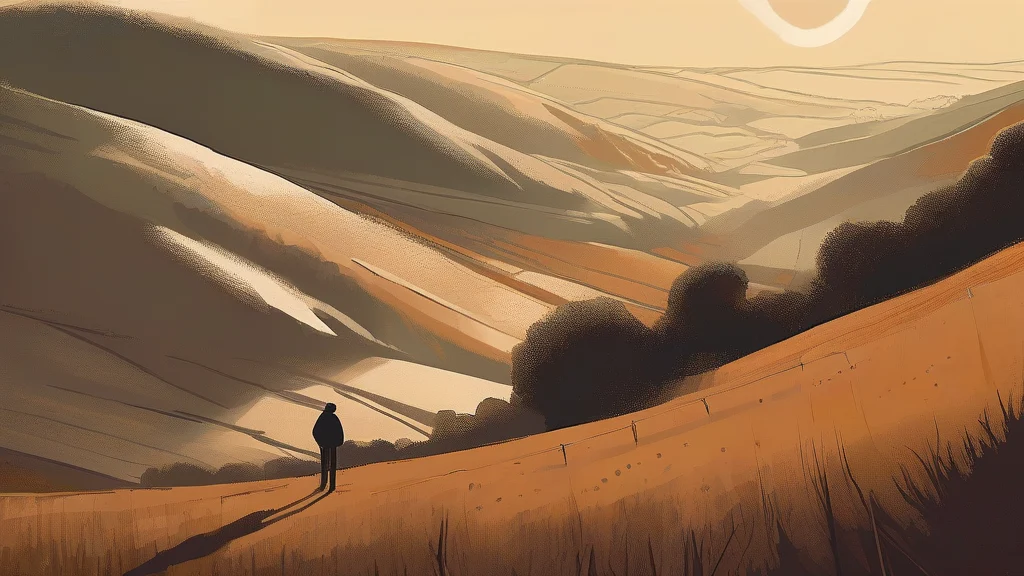
A coomb is a short, steep-sided valley or hollow cut into a hillside, a landform especially characteristic of the chalk downlands of southern England. The term belongs to the family that includes the spellings 'combe' and 'coombe' and ultimately derives from the same ancient root as the Welsh word 'cwm', reflecting a shared Brittonic Celtic heritage that long predates modern English. Coombs are typically dry or carry only seasonal streams, and their sheltered, often south-facing slopes have made them favoured sites for woodland, wildflowers, and human settlement since prehistoric times. The word survives most vividly in British place names — countless villages ending in '-combe' preserve it — though it remains current in landscape description, walking guides, and naturalist writing. An unrelated historical sense of 'coomb' as a former unit of grain measurement has largely fallen from use.
A short, steep-sided valley or hollow on a hillside, typical of chalk or limestone uplands.
"They followed the track as it dipped into the cool shade of the coomb."
Interchangeable with 'combe' and 'coombe'; the choice of spelling varies by region and by individual place name.
(Historical) An old English unit of capacity for dry goods, especially grain, equivalent to roughly four bushels.
"The tenant owed his lord two coombs of wheat each Michaelmas."
Obsolete; encountered only in historical documents and accounts of medieval agriculture.
Regular plural; used when speaking of several such valleys, e.g. in describing downland topography.
"The map showed a chain of coombs running along the scarp slope."
This humble word for a little valley shares its ancient Celtic roots with the Welsh 'cwm' — and it was once also a unit for measuring grain.
Reviewed by Deb Chak, Editor. AI-assisted content curated by RJS Tech Solutions LLP.
Etymology of coomb
Coomb derives from Old English 'cumb', meaning a bowl or vessel-shaped valley, which itself was likely borrowed from a Brittonic Celtic source; it is a direct cognate of the modern Welsh 'cwm'. The word has been part of the English landscape vocabulary since the early medieval period, surviving today in three interchangeable forms: 'coomb', 'combe', and 'coombe'. Its persistence in thousands of British place names testifies to its deep roots in the naming of southern England's countryside.
How coomb is actually used
Chiefly British and strongly associated with southern English landscape vocabulary, particularly the chalk Downs of Sussex, Dorset, Wiltshire, and Kent. The spelling 'coombe' is at least as common as 'coomb', and place names frequently preserve it (e.g. the many '-combe' villages of Devon and Somerset). In American English the word is rare, appearing mainly in borrowed place names.
Easily confused with coomb
A comb is a toothed implement used for grooming hair or a crest on an animal's head, whereas a coomb is a geographical feature — a small valley.
Coombe is merely the more common spelling variant of the same word, both referring to a short steep-sided valley.