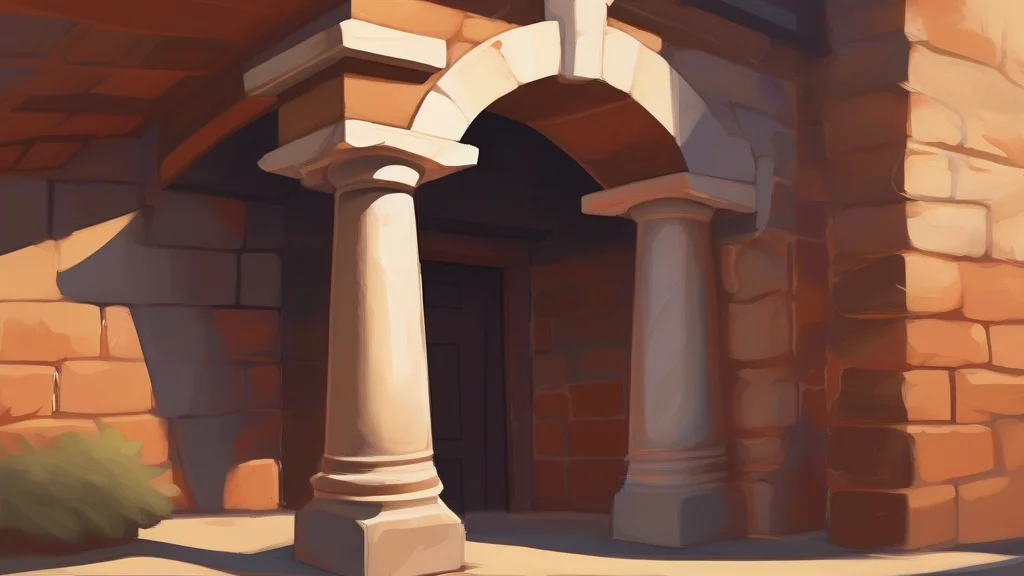
What does corbel mean?
A corbel is a structural element in architecture: a block of stone, brick, or timber that projects horizontally out of a wall to carry a load above it, such as a cornice, an arch springer, a beam end, or a balcony. Unlike a simple bracket fixed onto a wall face, a corbel is built into the masonry itself, often formed by stacking courses that each project slightly further than the one below — a technique called corbelling, which was used to create corbel arches and domed vaults long before true arches were widespread. The word derives ultimately from the Latin 'corvus', meaning raven, via Old French, reflecting early builders' impression that these projecting blocks resembled a crow's or raven's beak. Today the term appears mainly in architectural history, conservation, and construction, describing features from medieval machicolations and chimney supports to decorative mantelpiece brackets.
A short bracket of stone, brick, or wood projecting from a wall to support a cornice, arch, balcony, or other structural member.
"Gargoyles on Gothic cathedrals are often set atop corbels that project from the tower walls."
Used primarily in architecture, building trades, and archaeological description.
To construct by setting each course of masonry slightly beyond the one below it, so as to project gradually outward.
"The builders corbelled the upper courses inward until they met at the crown of the dome."
Usually appears in participial forms 'corbelled/corbelling' (British) or 'corbeled/corbelling' (US).
Standard plural for both the architectural feature and related uses.
"The arcade is supported by a row of finely carved Norman corbels."
The word 'corbel' literally means 'little raven' — builders thought the beak-shaped bracket resembled a bird's head.
Reviewed by Deb Chak, Editor. AI-assisted content curated by RJS Tech Solutions LLP.
Etymology of corbel
The English word 'corbel' entered the language in the late Middle Ages from Old French 'corbel', a diminutive form meaning 'little raven', itself derived from the Late Latin 'corvellus', a diminutive of Latin 'corvus' ('raven'). The name arose because the projecting, tapering shape of the bracket reminded builders of a bird's beak. The same Latin root gives us 'corvine', relating to crows and ravens, and underlies the name of the seabird 'cormorant' (literally 'sea-raven').
Related word forms
How corbel is actually used
Chiefly used in architecture, archaeology, and construction contexts; largely technical register, rarely heard in everyday conversation. The verb form is more common in British writing as 'corbelling' and American writing as 'corbeling'.
Easily confused with corbel
A console is an ornamental S-shaped bracket, whereas a corbel is the broader architectural term for any stepped or projected block built into a wall to carry a load.