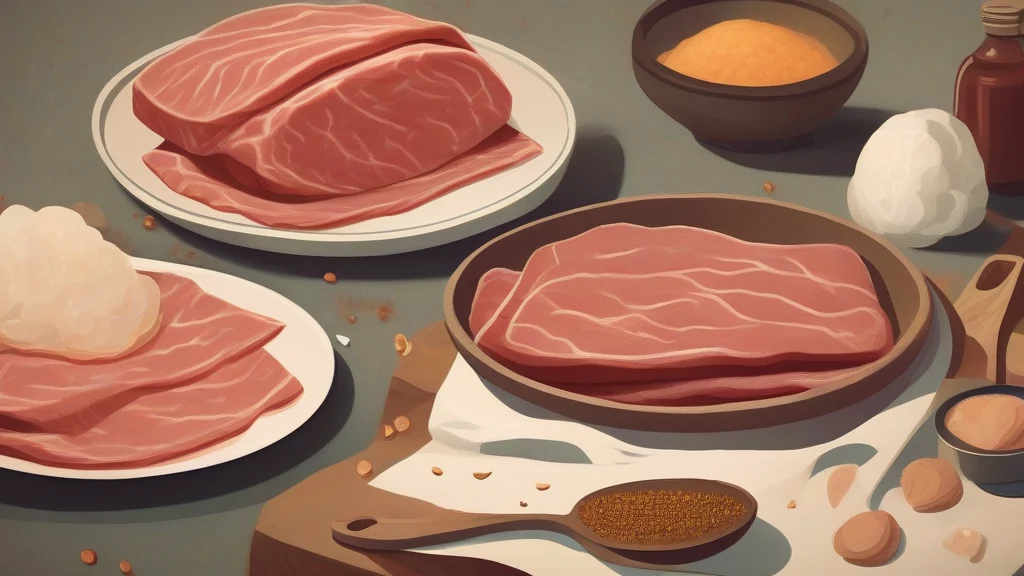
What does corned mean?
Corned is an adjective describing meat that has been cured or preserved using large, coarse grains of salt — grains that English speakers once simply called 'corn,' long before the word became tied to maize. By far its most familiar appearance is in corned beef, a salty, pink cured brisket beloved in delicatessens and traditionally served with cabbage on St Patrick's Day in the United States, while in Britain it often arrives tinned as a store-cupboard standby. The curing process draws out moisture and inhibits bacterial growth, giving the meat its distinctive texture and long shelf life. Though the word sounds archaic, it survives vividly in everyday speech almost entirely through this single culinary pairing. Its homely, hearty associations make it less a technical term than a comfort-food signifier, instantly evoking sandwiches, slow-simmered dinners, and old-world preserving methods.
Cured or preserved with coarse grains of salt; used especially of beef.
"He ordered a pastrami and corned beef on rye."
Virtually always found attributively before a noun, above all in 'corned beef'.
Past participle of the verb 'corn': to preserve or season with grains of salt.
"The butcher corned the brisket himself using his grandfather's recipe."
As a verb form it is uncommon in modern usage outside specialist butchery contexts.
Despite its name, corned beef contains no corn at all — the 'corns' are the large grains of rock salt once used to cure it, from an old English sense of 'corn' meaning any small hard particle.
Reviewed by Deb Chak, Editor. AI-assisted content curated by RJS Tech Solutions LLP.
Etymology of corned
The word traces to the Old Norse-derived Middle English 'corn,' which originally meant a small, hard particle or grain of any kind — not only cereal kernels but also grains of salt. From medieval times onward, meat preserved by rubbing with such granular salt was said to be 'corned.' As 'corn' came to mean specifically maize in American usage, the older sense faded, surviving chiefly in 'corned beef.' Cognate forms appear across Germanic languages, all pointing back to the Proto-Germanic root *kurną, 'grain,' which also gives us 'kernel' and 'grain' via related paths.
Related word forms
How corned is actually used
Almost exclusively encountered in the phrase 'corned beef'; the standalone use is rare outside food writing. The word carries a hearty, old-fashioned, deli-counter connotation rather than a formal one. In American culture it is strongly associated with Irish-American cuisine, though the dish itself is largely an American invention; in Britain, tinned corned beef is a common pantry staple.
Easily confused with corned
"Corned" refers to meat preserved with grains of salt, while "corny" describes something trite, sentimental, or clichéd.