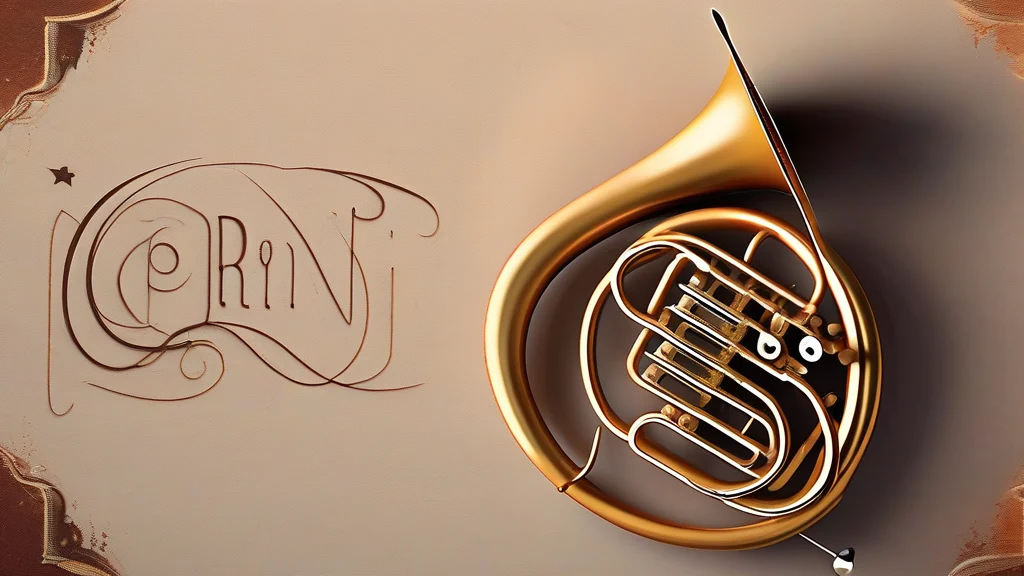
What does corni mean?
Corni is the Italian plural of 'corno', meaning 'horns', and it survives in English almost exclusively as a term of art in classical music. Orchestral scores, part names, and programme notes — especially those following Italian conventions — use corni to designate the horn (French horn) parts, so a symphony might be described as scored for two flutes, oboes, and four corni. Outside musical circles the word also denotes animal horns or horn-shaped objects in Italian-language contexts, but that sense rarely appears in English text. The word derives ultimately from the Latin 'cornu' ('horn'), the same root that gives us 'cornucopia', 'unicorn', and 'cornet'. For general readers, 'horns' or 'horn section' is the natural English equivalent; knowing corni is useful chiefly for reading scores, concert programmes, or Italian musical writing, where it signals the warm, rounded voice of the horn family rather than any single instrument.
nounThe plural of the Italian word 'corno', meaning 'horns'; in English it is used chiefly as a musical term referring collectively to the horn (French horn) players or horn parts in an orchestra or score.
- A collective term for horns (French horns) or their players/parts, especially in musical scores and discussions using Italian terminology.
- The Italian plural of 'corno' (horn), including animal horns and horn-shaped objects in Italian-language contexts.
"The score calls for two flutes and four corni in the third movement."
"The composer scored the passage for four corni, giving the fanfare its rich, blended warmth."
"In the concert programme, the wind section was listed as flauti, oboi, clarinetti, fagotti, and corni."
Corni is already a plural form borrowed from Italian; the singular is 'corno'. It does not take an English-style '-s'.
"The symphony's scoring includes three corni alongside the trumpets and trombones."
When an Italian score says 'corni', it isn't asking for vegetables — it's summoning the noble French horns.
Reviewed by Deb Chak, Editor. AI-assisted content curated by RJS Tech Solutions LLP.
Etymology of corni
Corni is the plural of the Italian 'corno', which descends directly from the Latin 'cornu', meaning 'horn'. The same Latin root produced English cognates such as 'cornucopia' (literally 'horn of plenty'), 'unicorn' (one-horned), and 'cornet', whose name reflects its small, horn-like shape. The term entered English usage through musical practice, since Italian was the traditional language of musical terminology across Europe.
How corni is actually used
Corni is essentially an Italian loan term retained in English mainly by musicians, musicologists, and readers of scores; ordinary English usage would simply say 'horns' or 'horn section'. It is technical rather than conversational vocabulary.
Easily confused with corni
A cornet is a single brass instrument similar to a trumpet, whereas corni is a plural term meaning 'horns'.
'Corny' is an adjective meaning trite or sentimental, while corni is a noun referring to horn instruments.