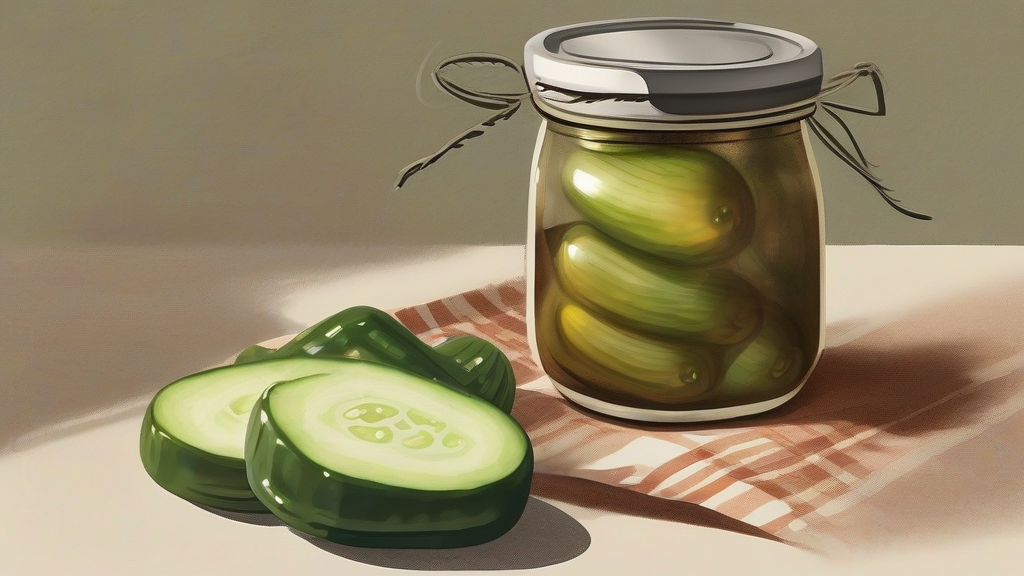
What does cornichon mean?
A cornichon is a tiny cucumber that has been pickled in vinegar or brine, prized in European cooking for its sharp, tangy bite and crisp texture. Borrowed into English from French, where it literally means 'little horn' — a nod to the vegetable's slightly curved shape — the word evokes classic French dining. Cornichons are a staple of charcuterie boards, accompanying pâtés, terrines, cured meats, and rich dishes whose fattiness their acidity cuts through. They are also commonly served alongside steak tartare and raclette. Because they are picked very young and small, cornichons are more delicate than larger dill pickles, and their tartness makes them a distinctive garnish rather than a casual snack. The term signals a certain culinary sophistication: menus that specify cornichons are usually drawing on French tradition. For cooks and diners alike, knowing the word helps distinguish these petite, vinegary pickles from their larger American counterparts.
nounA small cucumber pickled in vinegar or brine, typically served as a garnish or accompaniment in European cuisine; a gherkin of the small French variety.
- A very small cucumber preserved in vinegar or brine, eaten as a pickle or garnish, especially in French cuisine.
"The charcuterie board arrived with cornichons, grainy mustard, and slices of pâté."
"She speared a cornichon from the jar to accompany her pâté."
"The bistro served steak frites with a side of cornichons and shallot sauce."
Standard English plural, identical to the French plural. Commonly pluralized since cornichons are usually discussed in quantities.
"A generous handful of cornichons brightened the charcuterie platter."
The word 'cornichon' literally means 'little horn' in French — the tiny pickle was named for its curved shape, not its flavor.
Reviewed by Deb Chak, Editor. AI-assisted content curated by RJS Tech Solutions LLP.
Etymology of cornichon
The word 'cornichon' comes from French, where it is a diminutive form derived ultimately from Latin cornu, meaning 'horn', reflecting the small cucumber's horn-like curve. It entered English as a culinary borrowing, likely in the nineteenth century, alongside growing British and American enthusiasm for French cuisine. It shares this Latin root with words such as 'unicorn', 'cornucopia', and 'corner', all tracing back to the notion of a horn or pointed projection.
How cornichon is actually used
Borrowed directly from French and still strongly associated with French gastronomy, 'cornichon' carries a connotation of refinement compared with the more everyday 'pickle' or 'gherkin'. Both singular and plural forms are used; the plural is common when describing jars or platters. The final '-on' is often pronounced with a light French nasal quality by speakers familiar with the cuisine, though an anglicized vowel is standard.
Easily confused with cornichon
A gherkin is any pickled young cucumber, while a cornichon specifically refers to the tiny French-style gherkin pickled in tart vinegar.
A corniche is a road built along a cliff or coastline, whereas a cornichon is a small pickled cucumber.