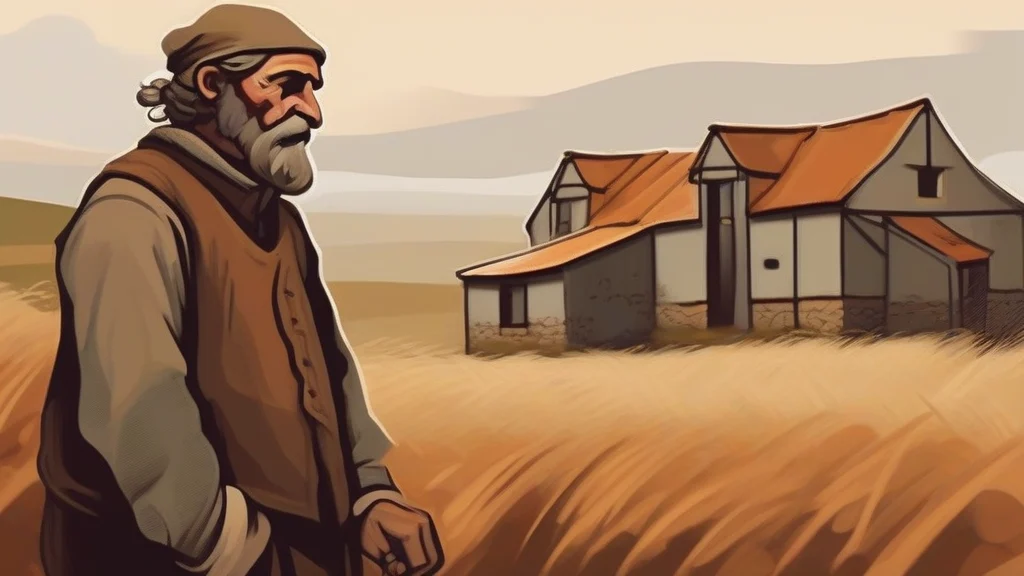
What does cottar mean?
A cottar is a farm labourer or small peasant who occupies a cottage not by paying rent but by providing labour to a landlord or principal tenant. The term belongs chiefly to the rural history of Scotland and Ireland, where cottars formed the lowest tier of the farming population: they might cultivate a modest patch of oats or keep a cow on common grazing, but their security of tenure rested on the goodwill of the laird or farmer whose land they worked. The word derives from Old English 'cote', meaning a hut or shelter — the same root that gave us 'cottage' — so a cottar is literally 'a person tied to a cot'. Today 'cottar' survives almost exclusively in historical writing, genealogy, and literature about Highland and Irish rural life, where it conjures images of turf-roofed huts, subsistence plots, and the precarious existence of those who lived close to the edge of eviction.
nounA peasant or farm labourer who occupies a cottage in return for labour rather than rent; historically, a small tenant farmer holding land by such an arrangement, chiefly in Scotland and Ireland.
- A farm labourer or peasant occupying a cottage on a farm in return for labour rather than money rent.
- (Historical, Scotland) A small tenant holding a few acres of arable land attached to a cottage, subordinate to the main tenants of an estate.
"In the eighteenth-century Highlands, the cottar worked the laird's fields in exchange for his bare plot of ground and turf-roofed hut."
"Each spring, the cottar and his sons turned out to cut peat for the estate before tending their own strip of oats."
"The census of 1841 recorded dozens of cottars living along the glen, most of them illiterate labourers bound to seasonal work."
Regular plural; used when referring to the class of such labourers collectively, e.g. in social histories of the Highlands or rural Ireland.
"The clearances displaced thousands of cottars who had farmed the straths for generations."
The cottar paid no rent at all — his family's shelter was bought entirely with sweat, working the laird's land from dawn to dusk.
Reviewed by Deb Chak, Editor. AI-assisted content curated by RJS Tech Solutions LLP.
Etymology of cottar
'Cottar' comes from Middle English 'coterie'/'cotere' formations built on 'cot', meaning a humble dwelling or hut, which descends from Old English 'cote'. It entered Scots usage as the standard term for a cottage-holding labourer, and the closely related Irish form 'cottier' developed independently in Anglo-Irish land terminology. The same root produced 'cottage' and 'cote', making these its closest English relatives.
How cottar is actually used
The word is now almost entirely historical, evoking pre-industrial rural life in Scotland and Ireland; it carries connotations of poverty and feudal dependence. In modern writing it appears mainly in history, genealogy, and literary contexts. The variant spellings 'cotter' and 'cotterman' also occur.
Easily confused with cottar
A cottager is simply someone who lives in a cottage (often as a small property owner or holiday-home dweller), whereas a cottar is specifically a historical farm labourer who held a cottage tenancy in return for work.
A cotter is chiefly a mechanical pin or fastener (as in 'cotter pin') or a variant spelling of the same agricultural term; the spelling 'cottar' is the traditional Scottish and Irish form for the farm worker.