What does couscous mean?
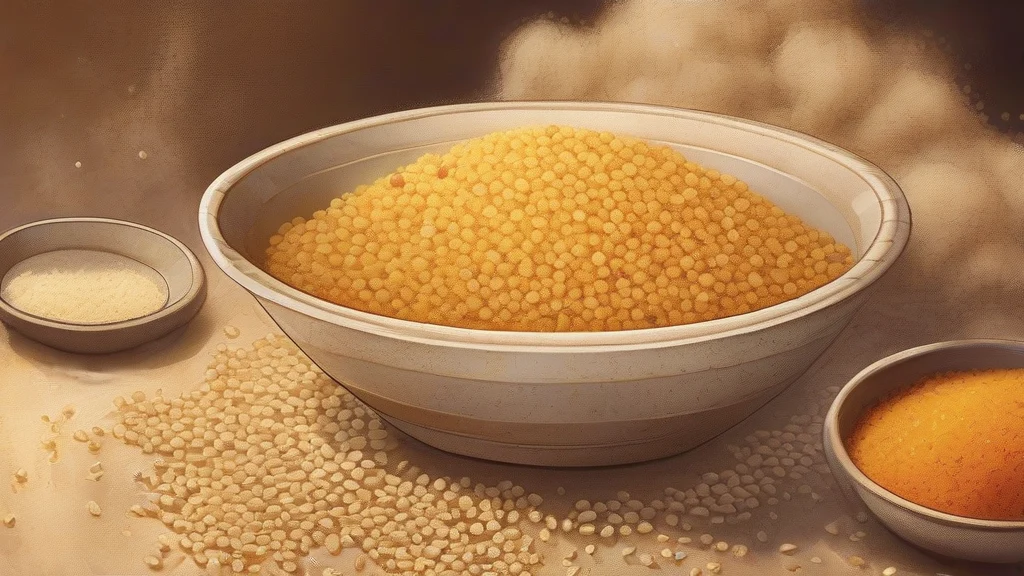
Couscous is a staple food of North African origin consisting of tiny granules of durum-wheat semolina that have been moistened, rolled, and dried, then cooked — traditionally by steaming — until light and fluffy. It serves both as an ingredient and as a dish in its own right: across Morocco, Algeria, Tunisia, and Libya it forms the base of a celebrated meal, typically piled with a savory stew of meat and vegetables. In Britain, America, and beyond, quick-cooking instant couscous has become a popular side dish or salad base, valued for its speed and mild, nutty flavor. Though often mistaken for a grain, couscous is more accurately described as a very small pasta, since it is made from processed wheat rather than harvested directly as a whole grain. Related products include pearl (Israeli) couscous, which features larger, rounder granules suited to salads and soups.
Small granules of rolled semolina wheat, steamed and served as a food staple, especially in North African cuisine.
"Add the stock to the couscous, cover, and let it absorb for five minutes."
Usually treated as an uncountable (mass) noun in English; a plural form is not normally used.
A dish consisting of these granules served with stew, meat, or vegetables spooned over them.
"Friday lunch at her grandmother's house always meant couscous with seven vegetables."
This sense refers to the complete traditional meal rather than the ingredient alone.
Couscous is almost always used as an uncountable mass noun in English; a plural is virtually never needed and would sound unnatural. When referring to different types, use constructions like 'types of couscous' instead.
"The restaurant offers several varieties, but calling them 'couscousses' would be highly unusual."
Couscous is often called the world's smallest pasta — each grain is hand-rolled semolina dough, and in North Africa preparing it well was traditionally considered a mark of a skilled cook.
Reviewed by Deb Chak, Editor. AI-assisted content curated by RJS Tech Solutions LLP.
Etymology of couscous
The word couscous entered English from French, during the colonial period in North Africa, most commonly cited as the mid-19th to early 19th century. French borrowed it from Algerian Arabic kuskus, which ultimately traces back through Berber languages such as Kabyle seksu, reflecting the dish's deep roots in the Maghreb. Cognates appear throughout North African Arabic and Berber dialects, including Moroccan Arabic seksu and Tunisian Arabic kosksi. The doubled consonant-vowel structure of the word is characteristic of the Maghrebi source languages rather than an English formation.
How couscous is actually used
Couscous functions almost exclusively as an uncountable noun; it has no plural in normal culinary usage. It carries no strong connotation — it reads as neutral-to-wholesome, associated with North African and Mediterranean cooking. Instant (pre-steamed) couscous, common in Western supermarkets, cooks in minutes by soaking, while traditional couscous requires prolonged steaming. Variants include pearl or Israeli couscous, which has larger grains.
Easily confused with couscous
Quinoa is a seed of a flowering plant related to spinach, whereas couscous is made from wheat semolina and is therefore not gluten-free.
Bulgur consists of cracked, parboiled whole wheat grains, while couscous is made from finely ground semolina dough rolled into tiny pellets.