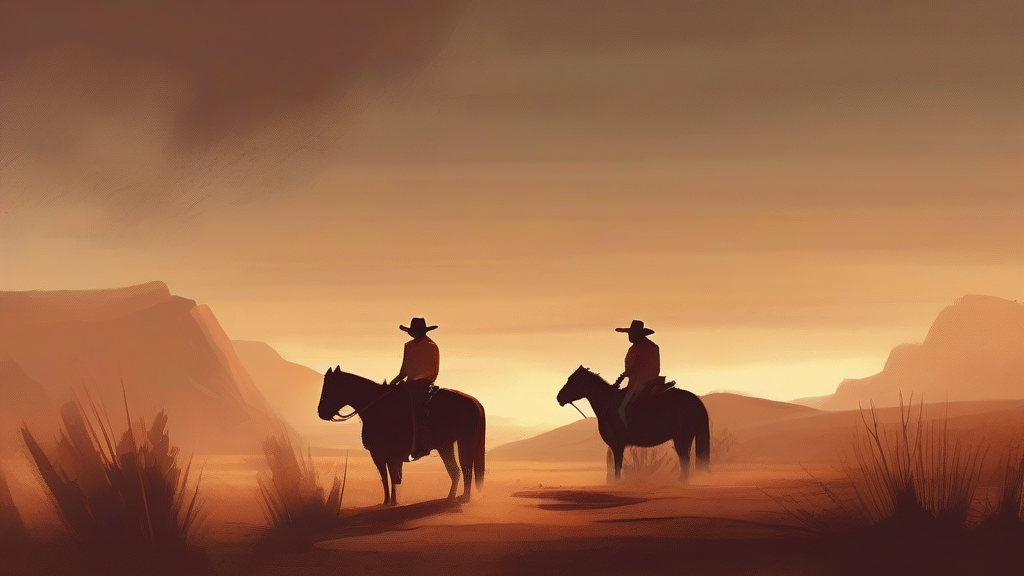
What does cowboy mean?
A cowboy is a man who herds and tends cattle on horseback, a figure closely associated with the ranching culture of the American West during the second half of the nineteenth century. The role grew out of Spanish and Mexican traditions brought north by vaqueros, whose techniques and vocabulary shaped American ranch life. Beyond its literal meaning, 'cowboy' has developed an important figurative sense: someone who acts recklessly or flouts established rules and safety standards, as in 'cowboy builders.' This figurative use is especially common in British English, where it reliably signals disapproval, while in American usage the term often retains romantic connotations of independence, self-reliance, and rugged freedom. The word also appears widely in popular culture, fashion ('cowboy boots,' 'cowboy hat'), and idioms such as 'riding shotgun' adjacent imagery of the open range. Its enduring cultural weight makes it one of the most recognizable occupational words in English.
A man who herds and manages cattle on horseback, especially one working on a ranch in western North America.
"As a young cowboy he learned to break horses and drive cattle over long distances."
Often used romantically or nostalgically in American culture; the female equivalent is 'cowgirl.'
Informal or derogatory: a person who is reckless, unscrupulous, or careless about rules and standards, especially in trade or business.
"The report warned consumers to watch out for cowboy builders offering cheap repairs."
Particularly common in British English, where phrases like 'cowboy builders' are well established.
Standard regular plural; used for both the literal and figurative senses.
"The trail was crowded with cowboys heading north with their herds."
The iconic American 'cowboy' actually descends from Spanish colonial vaqueros of Mexico, who taught their skills — including the word 'buckaroo,' from 'vaquero' — to English speakers.
Reviewed by Deb Chak, Editor. AI-assisted content curated by RJS Tech Solutions LLP.
Etymology of cowboy
The word 'cowboy' arose in English as a straightforward compound of 'cow' and 'boy,' first used in the eighteenth century for boys or men who tended cattle. It took on its distinctive modern meaning in nineteenth-century America, where it was applied to the mounted cattlemen of the western plains. The occupation itself derives largely from Mexican vaqueros, Spanish colonial herdsmen whose equipment and methods were adopted by Anglo-American ranchers; this influence survives in related terms such as 'buckaroo' (from 'vaquero') and 'rodeo.'
Related word forms
How cowboy is actually used
In British English especially, 'cowboy' carries strong negative connotations when used figuratively, describing shoddy tradesmen or careless operators. In American usage it can be neutral, romanticized, or even admiringly applied to bold, independent figures. The feminine equivalent is 'cowgirl.'
Easily confused with cowboy
A cowherd tends cattle on foot, traditionally in Britain or Europe, while a cowboy is specifically the mounted cattle worker of the American West.