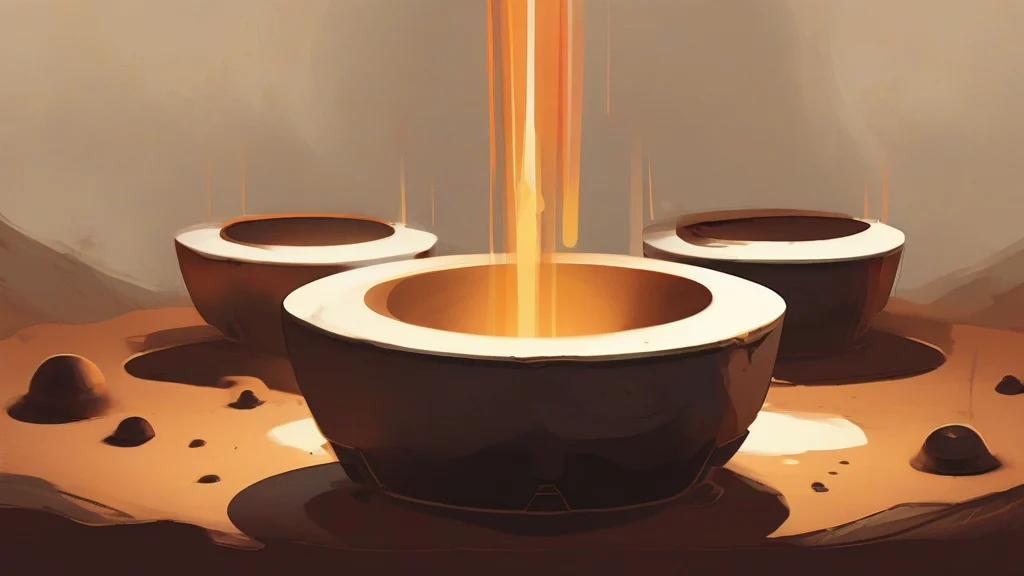
What does crucible mean?
A crucible is a vessel made of ceramic, graphite, or metal that can withstand extremely high temperatures, used to melt metals, ores, and other substances. Because such vessels are central to refining and forging, the word acquired a powerful figurative meaning: a crucible is any severe test or transformative ordeal in which character, ideas, or institutions are tried and reshaped. One might speak of a person being tempered 'in the crucible of war' or a nation being forged 'in the crucible of revolution.' The figurative sense now predominates in journalism, history, and literature, lending gravity to descriptions of hardship and change, while the literal sense remains common in metallurgy and chemistry. The word's evocative force comes from this blend of fire, endurance, and rebirth, making it one of English's most resonant metaphors for transformation under pressure.
A ceramic or metal container capable of withstanding extreme temperatures, used for melting and refining metals or other substances.
"Molten bronze was ladled out of the white-hot crucible and poured into the mould."
This is the original, literal sense, still standard in metallurgy, foundry work, and laboratory science.
A figurative crucible: a situation or environment of intense pressure, trial, or conflict in which people or things are tested and fundamentally changed.
"The postwar decade proved a crucible in which modern Europe was reforged."
This extended sense is by far the more common usage today, especially in historical and political writing.
Regular plural formation; used when referring to multiple vessels or multiple figurative trials.
"The laboratory stocked several porcelain crucibles for high-temperature experiments."
The word 'crucible' literally means 'little cross' — a nod to the cross-shaped base of medieval melting pots — which makes it a cousin of 'crucial' and 'excruciating'.
Reviewed by Deb Chak, Editor. AI-assisted content curated by RJS Tech Solutions LLP.
Etymology of crucible
Crucible entered English in the late Middle Ages (around the 15th century), most likely via Medieval Latin 'crucibulum' or Old French. Its ultimate origin lies in Latin 'crux' (cross) or 'cruciare', possibly referring to the cross-shaped support or lamp-stand of early vessels, though some scholars connect it instead to Germanic roots. It shares its root family with words such as 'crucial', 'crux', and 'crucify', all descended from Latin terms built on 'crux'. The figurative sense developed naturally from the vessel's role in purifying metals through intense heat.
How crucible is actually used
The figurative sense dominates in modern writing, especially in political, historical, and literary contexts, where it carries connotations of hardship leading to refinement or transformation. The literal metallurgical sense persists mainly in technical, industrial, and scientific writing. The plural form is standard.
Easily confused with crucible
A cruet is a small glass bottle for oil, vinegar, or condiments at the table, whereas a crucible is a heat-resistant vessel for melting substances at very high temperatures.