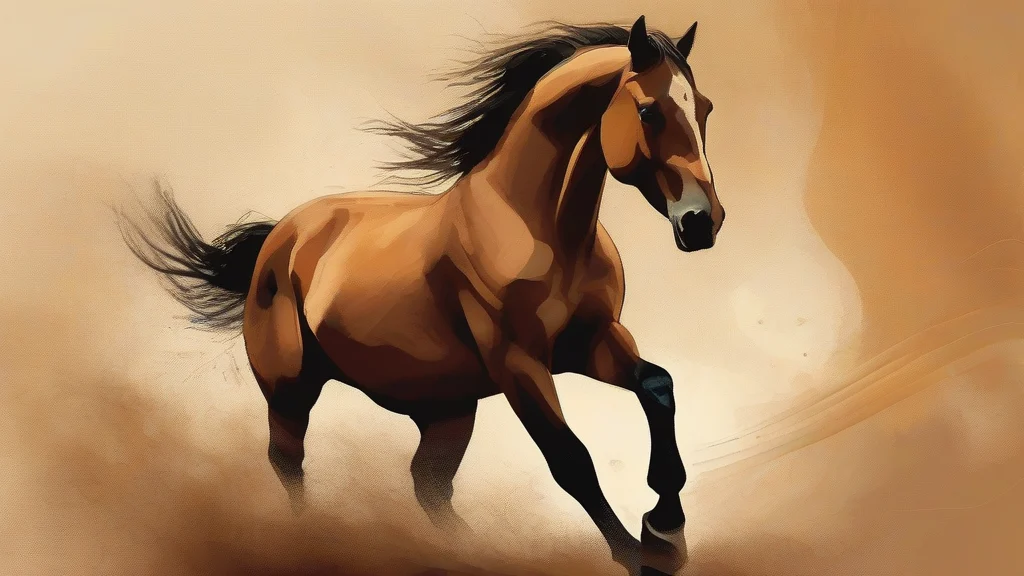
What does curvetting mean?
Curvetting refers to the spirited action of a horse performing curvets — a sequence of light, springing leaps in which the animal rears briefly onto its hind legs and kicks out behind as it lands. The term functions both as a noun naming this movement and as the present participle of the verb 'curvet'. It belongs firmly to the vocabulary of horsemanship: classical riding masters prized the curvet as a demonstration of balance, agility, and trained exuberance, and the word survives today mainly in dressage, equestrian literature, and descriptive writing about high-spirited mounts. Figurative use is uncommon, though writers occasionally apply it playfully to anything bounding with energy. The double-t spelling is traditional in Britain, while American texts typically prefer 'curveting'. Derived ultimately from Latin roots meaning a small curve, the word carries connotations of grace and controlled liveliness — energy held elegantly within form.
The action of leaping in curvets; a series of light, springing bounds made by a horse on its hind legs.
"The stallion's curvetting delighted the crowd gathered along the paddock rail."
Making such leaps; moving forward with playful, springing bounds.
"The pony went curvetting across the meadow after being turned out for the summer."
When a dressage judge writes that your horse was curvetting, it's not a complaint — the word traces back through French to Italian, and ultimately to Latin for 'a little curve'.
Reviewed by Deb Chak, Editor. AI-assisted content curated by RJS Tech Solutions LLP.
Etymology of curvetting
Curvetting derives from the verb 'curvet', which English adopted from French 'courvette', itself from Italian 'corvetta', a diminutive formation ultimately rooted in Latin 'curvus' (bent, curved). The word entered English in the 16th century alongside the fashionable Italian-influenced art of managed riding, describing one of the celebrated airs above the ground. Its double-t spelling reflects older British orthographic convention, while the single-t 'curveting' became standard in America.
Related word forms
How curvetting is actually used
Chiefly used in equestrian contexts and largely formal or literary in register. The spelling with a double 't' is the traditional British form; American usage more commonly uses the single-t spelling 'curveting'. Outside descriptions of horses, the word is rare.
Easily confused with curvetting
'Carpeting' means floor covering or fitting a carpet, while 'curvetting' describes a horse's springing leaps — the words share a similar rhythm but nothing else.