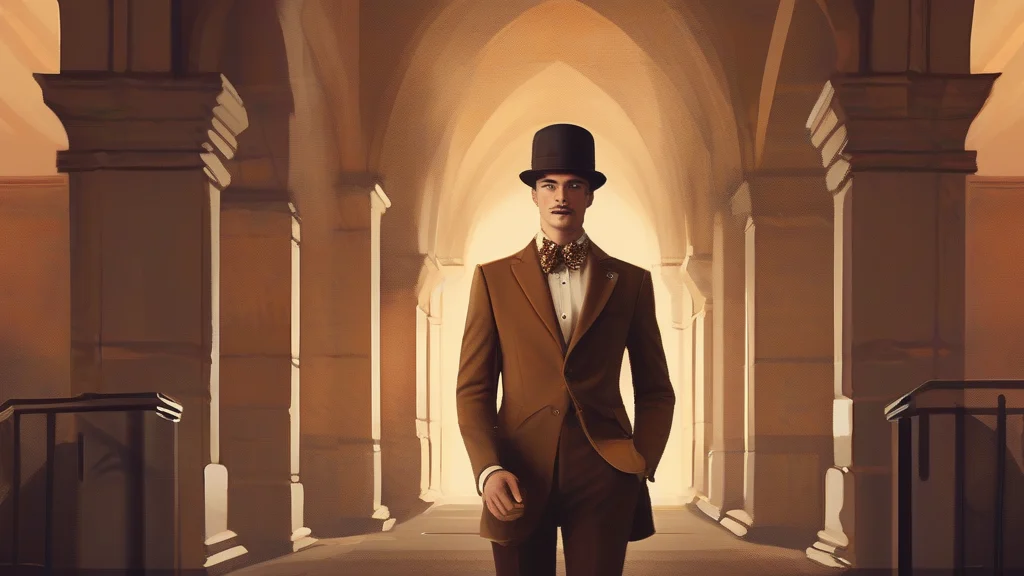
What does dandyism mean?
Dandyism is the practice or philosophy of being a dandy — a person who devotes extraordinary attention to elegant dress, grooming, and refined manners. Emerging in late eighteenth- and early nineteenth-century Britain, it reached its height with figures such as Beau Brummell, whose understated but immaculate tailoring set the standard for Regency gentlemen, and later found artistic expression in writers like Baudelaire and Oscar Wilde. More than mere vanity, dandyism has often been treated as a form of self-discipline, aesthetic rebellion, or social commentary: the dandy turns his own appearance and comportment into a statement of individuality against conformity. The noun is chiefly used in historical, literary, and fashion contexts, and while it can suggest affected elegance, it frequently carries an admiring or at least sympathetic connotation. Related forms include the nouns dandy and the adjectives dandyish and dandiacal.
nounThe style, practice, or cult of being a dandy — an excessive concern with elegant dress, refined manners, and cultivated appearance, often as a form of self-expression or social statement.
- The practice or principles of a dandy: meticulous devotion to elegant dress, grooming, and personal refinement, sometimes elevated to an aesthetic or philosophical stance.
- The spirit or manner characteristic of dandies; affected elegance or fastidiousness in behavior and taste.
"His dandyism was less about vanity than about turning everyday life into a work of art."
"Beau Brummell's dandyism transformed men's fashion in Regency England, favoring immaculate tailoring over ostentatious ornament."
"Critics dismissed the poet's dandyism as mere affectation, but he insisted it was a disciplined art of self-creation."
Rarely pluralized; the plural appears only when discussing multiple distinct styles or schools of dandyism across eras or cultures.
"Historians have traced distinct dandyisms in Regency London, Second Empire Paris, and Harlem Renaissance New York."
For the great dandies of the 19th century, getting dressed was not vanity — it was philosophy: Beau Brummell claimed to spend five hours a day on his toilette, and Oscar Wilde called his own life his greatest work of art.
Reviewed by Deb Chak, Editor. AI-assisted content curated by RJS Tech Solutions LLP.
Etymology of dandyism
Dandyism derives from 'dandy,' a word of uncertain origin that first appeared in Scottish and English usage in the late eighteenth century, possibly as a playful or jocular formation. The suffix '-ism' (from Greek '-ismos' via Latin) converts it into a term for a practice, style, or doctrine. The word became widespread in the early nineteenth century to describe the cult of elegant dress associated with Beau Brummell and his imitators, and it spread through European languages, including French ('dandysme'), where it took on philosophical overtones through Baudelaire's writing.
Related word forms
How dandyism is actually used
The word is literary and somewhat formal. It often carries a neutral or even admiring tone in discussions of fashion history and aesthetics, though it can imply affectation when used critically. It is strongly associated with figures such as Beau Brummell, Charles Baudelaire, and Oscar Wilde.
Easily confused with dandyism
While closely related, 'foppery' carries a stronger connotation of foolish or ridiculous over-dressing, whereas 'dandyism' can be an admired, deliberate aesthetic philosophy.