
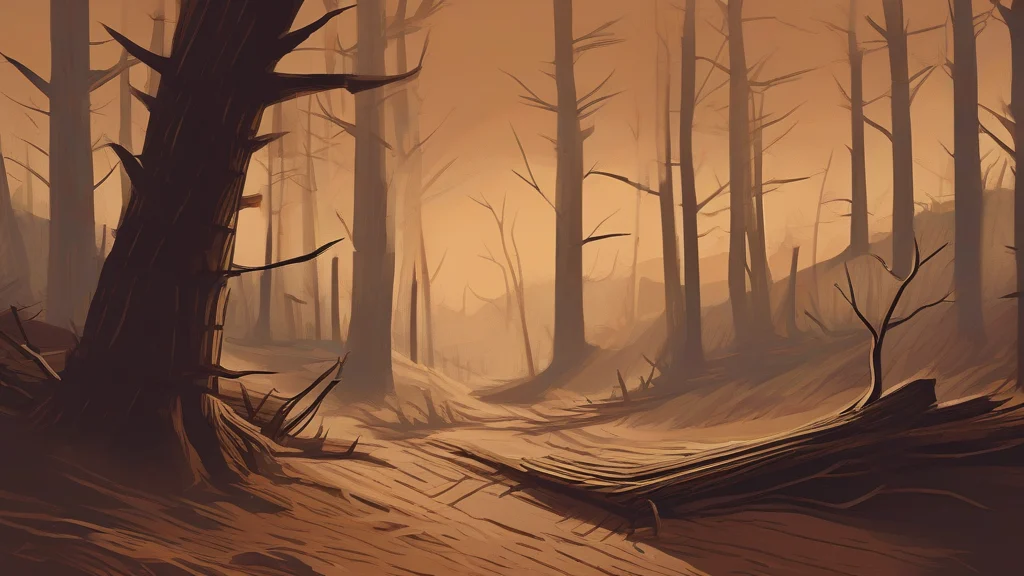
What does deadwood mean?
Deadwood refers literally to dead or dying branches on a tree, together with the fallen timber they leave scattered on the ground. Ecologically it is far from worthless: rotting logs and standing snags shelter insects, fungi, birds, and small mammals, making deadwood a cornerstone of healthy woodland ecosystems. The word also carries a well-known figurative meaning, describing people regarded as unproductive or obsolete within an organization — a usage popular in business journalism, where executives speak of 'clearing out the deadwood.' In nautical terminology, deadwood denotes the heavy solid timbers built up above the keel at a wooden ship's stem and stern, and in tenpin bowling it names pins that have been knocked down but not yet removed from the lane. The figurative sense is informal and slightly harsh in tone, so careful writers reserve it for pointed commentary rather than neutral description.
Dead or dying branches on a tree, or such timber lying on the ground.
"Dry deadwood crackled underfoot as we hiked through the pine forest."
Neutral in register; ecologists often stress its habitat value.
Informally, people regarded as inefficient or no longer contributing within an organization.
"The merger gave management cover to sweep out years of accumulated deadwood."
Derogatory; chiefly American business usage.
Nautical: solid timbers fastened above the keel at the stem and stern of a wooden vessel.
"The shipwright scarfed fresh oak into the deadwood before refastening the planking."
Tenpin bowling: fallen pins still standing or lying on the lane.
"The pinsetter cleared the deadwood between frames."
Usually treated as an uncountable mass noun; the plural 'deadwoods' appears mainly in nautical contexts referring to distinct timber assemblies, or figuratively for groups of ineffective people.
"Each of the ship's two deadwoods was replaced during restoration."
In bowling, 'deadwood' names the fallen pins that must be cleared before play can continue — which is exactly how managers use it about staff.
Reviewed by Deb Chak, Editor. AI-assisted content curated by RJS Tech Solutions LLP.
Etymology of deadwood
Deadwood is a straightforward English compound of 'dead' and 'wood', attested from around the early seventeenth century in its literal sense of lifeless branches and timber. Its nautical use arose during the age of sail, when shipwrights applied the term to the solid filler timbers worked into the hull above the keel. The figurative application to unproductive people developed later, likely in nineteenth-century America, echoing the image of useless material to be cleared away.
How deadwood is actually used
Literal use is neutral, though ecologists value deadwood highly as habitat. The figurative sense ('personnel deadwood') is informal and mildly derogatory, common in business writing.
Easily confused with deadwood
Driftwood is wood washed ashore by water, whereas deadwood is dead branches or timber on or from trees.