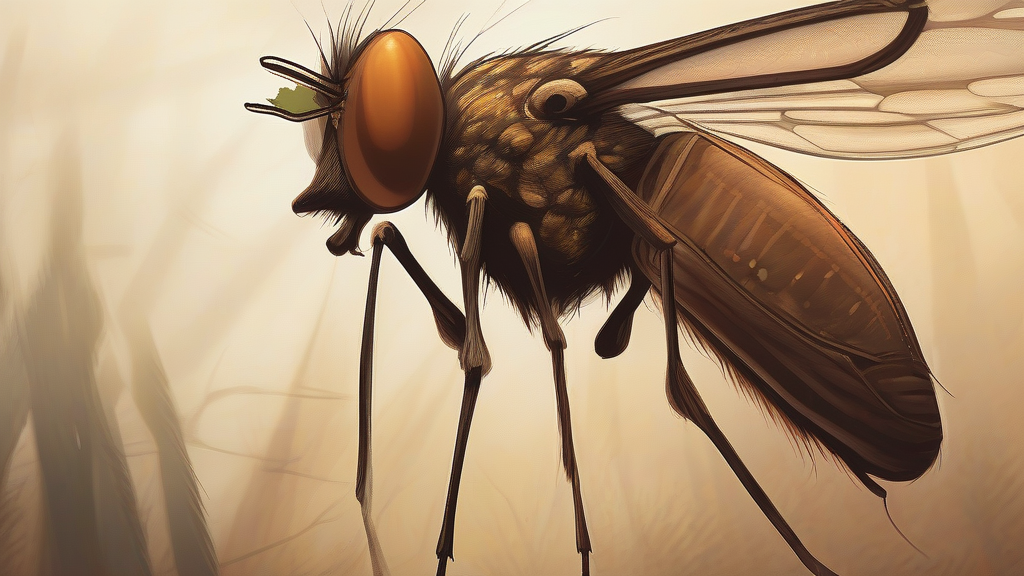
What does deerfly mean?
A deerfly is a biting insect belonging to the genus Chrysops within the family Tabanidae, making it a close relative of the larger horsefly. Found across much of North America, Europe, and Asia, deerflies favor damp, wooded habitats near water, where their larvae develop in mud or moist soil. Only the females take blood meals, which they need to mature their eggs; they deliver painful bites by slicing the skin with blade-like mouthparts. The name derives simply from the insects' habit of pestering deer, although they attack cattle, horses, and humans just as readily. In everyday speech the term may be applied loosely to any similar small biting fly. Deerflies are best known as a warm-weather nuisance for hikers, anglers, and campers, and they can also transmit diseases such as tularemia to animals and occasionally people.
nounA bloodsucking fly of the genus Chrysops (family Tabanidae), related to the horsefly, whose females bite humans and animals. Also more loosely, any similar biting fly found around deer and livestock.
- A biting fly of the genus Chrysops (family Tabanidae), whose females feed on the blood of mammals including humans.
- Loosely, any small biting fly resembling Chrysops that pesters deer, livestock, or people.
"The hikers were tormented by deerflies all along the lakeshore trail."
"We cut the fishing trip short because the deerflies were relentless near the marsh."
"A deerfly landed on the horse's flank, and it flicked its tail sharply to drive the insect away."
The standard plural replaces 'y' with 'ies'; the open spelling 'deer flies' takes the regular plural 'flies'.
"By mid-July the meadows were alive with deerflies."
Only the female deerfly bites — she needs a blood meal to produce her eggs, making every summer hike an unintended donation.
Reviewed by Deb Chak, Editor. AI-assisted content curated by RJS Tech Solutions LLP.
Etymology of deerfly
The word deerfly is a straightforward English compound formed from 'deer' (from Old English dēor, originally meaning 'animal') and 'fly' (from Old English flēoge), describing an insect notorious for tormenting deer. Such transparent animal-plus-fly compounds are ancient in English, paralleling older formations like 'horsefly' and 'gadfly'. The term has been in use since at least the eighteenth century in natural-history writing, and modern usage splits between the closed spelling 'deerfly' and the open form 'deer fly'.
How deerfly is actually used
The word is written variously as one word (deerfly) or two (deer fly); the closed form is common in American usage. It is an informal, everyday term rather than a technical one, and in entomological writing the genus name Chrysops is preferred for precision.
Easily confused with deerfly
A horsefly (genus Tabanus or related) is generally larger than a deerfly (genus Chrysops), though both are biting members of the family Tabanidae.