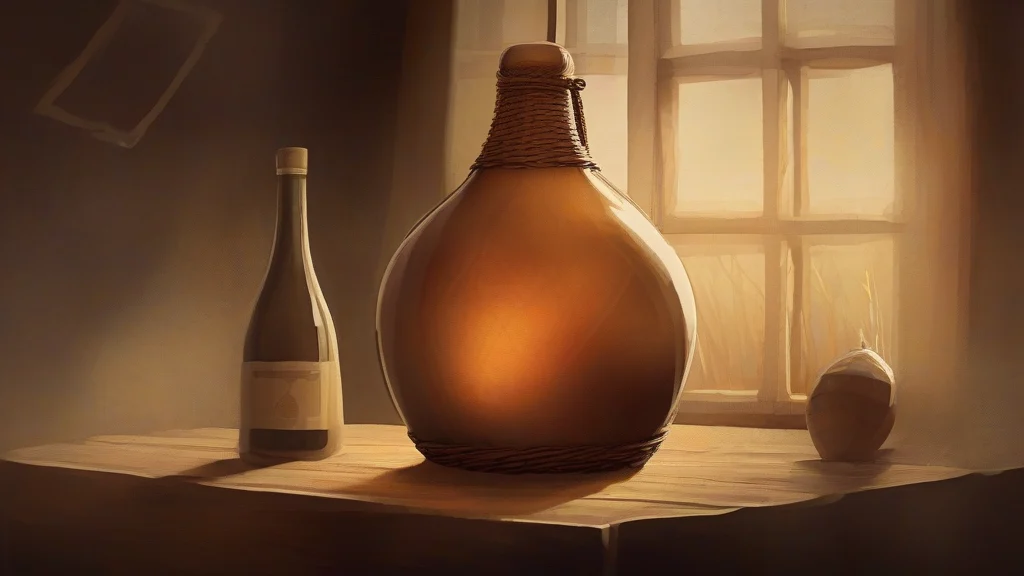
What does demijohn mean?
A demijohn is a large, bulbous glass vessel with a narrow neck, traditionally enclosed in a protective wicker or wickerwork case, and capable of holding around five gallons — roughly nineteen litres — of liquid such as wine, cider, oil, or vinegar. The word entered English in the eighteenth century, most plausibly from the French phrase 'dame-jeanne' ('Lady Jane'), though Italian 'damigiana' may also have influenced its form. Demijohns were once standard equipment in households, taverns, and merchant cellars across Britain and America, valued because their dark glass and woven covering protected contents from light while allowing large-volume storage. Today the term survives mainly among home brewers and winemakers, who use demijohns for secondary fermentation, as well as among collectors of antique glassware. It carries a pleasantly old-fashioned, rural connotation, evoking farm kitchens, country cellars, and traditional craft.
nounA large bulbous glass bottle or jug, typically holding five gallons (about 19 litres) and enclosed in a wicker or wickerwork case, used chiefly for storing wine, oil, or other liquids.
- A large bulbous glass container with a narrow neck, usually encased in wicker, holding roughly 5 gallons (about 19 litres) of liquid such as wine, oil, or vinegar.
"The cellar was lined with demijohns of homemade wine resting in their woven wicker cradles."
"He siphoned the elderflower cordial from the fermenting bucket into a clean demijohn for secondary fermentation."
"An old demijohn sat on the porch step, its wicker casing frayed from decades of use."
Standard regular plural; no irregular forms exist.
"Rows of dusty demijohns lined the back wall of the old general store."
The name 'demijohn' likely comes from French 'dame-jeanne' — literally 'Lady Jane' — so this humble winemaking bottle carries a woman's name in its very etymology.
Reviewed by Deb Chak, Editor. AI-assisted content curated by RJS Tech Solutions LLP.
Etymology of demijohn
The origin of 'demijohn' lies in early eighteenth-century English, borrowed most likely from the French 'dame-jeanne', literally 'Lady Jane', a folk name for such vessels. An alternative account traces it through Italian 'damigiana' ('of noble lady'), which may have shaped the anglicised form by association with 'demi-' meaning half. The prefix 'demi-' itself derives from Old French, ultimately from Latin 'dimidius' meaning half, and appears in many other English borrowings such as 'demigod' and 'demilune'. The word has remained remarkably stable in form and sense since its adoption.
How demijohn is actually used
The word has a slightly rustic, traditional register and is most often encountered today in contexts of home brewing, winemaking, antiques, and rural life. In modern commercial usage it is somewhat dated; 'carboy' is more common in contemporary brewing supply contexts. The plural is 'demijohns'.
Easily confused with demijohn
A carboy is a similar large glass vessel but typically rigid-framed or plastic-protected rather than wrapped in woven wicker, and the two words are not interchangeable in traditional usage.