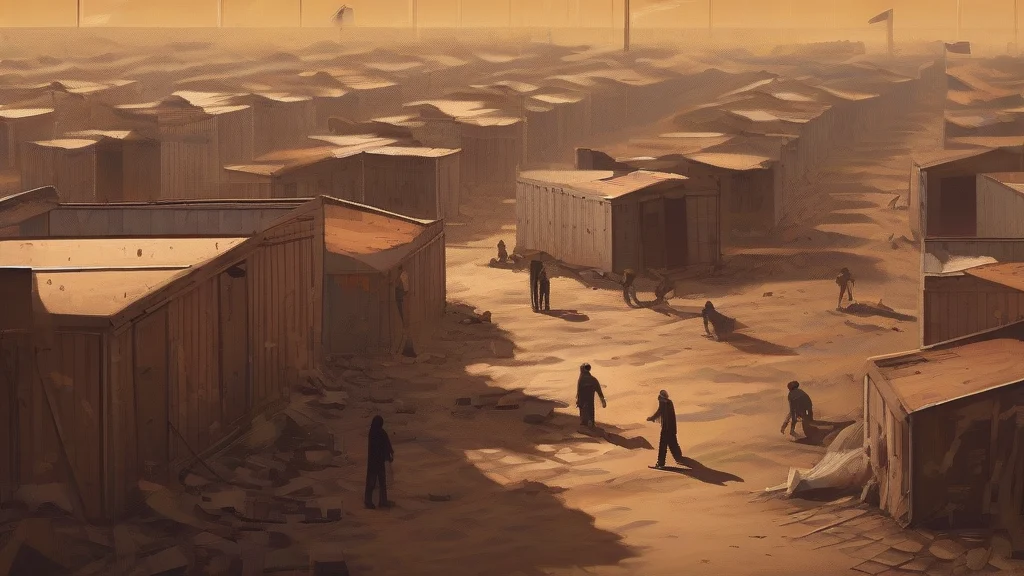
What does depopulating mean?
Depopulating is the present participle and gerund of the verb "depopulate," meaning to strip a place of its inhabitants or cause its population to dwindle. The process may unfold gradually, as when young people leave rural areas for cities, or abruptly, as in wartime evacuations, epidemics, or forced resettlement. The word is chiefly formal and appears most often in journalism, historical writing, and demographic or policy analysis. Its connotations are almost invariably negative: depopulation suggests decline, abandonment, and social or economic decay rather than mere change. Grammatically, it functions transitively ("the famine was depopulating entire provinces") and can also serve as a noun for the act itself ("the depopulating of the highlands"). Related forms include the base verb "depopulate," the past form "depopulated," and the noun "depopulation." Derived ultimately from the Latin "populus," meaning people, the word literally conveys the idea of un-peopling a landscape.
Present participle of "depopulate": reducing the number of inhabitants of a place, especially by driving them away or causing them to leave.
"Rising sea levels are slowly depopulating the island's coastal settlements."
Typically used transitively with an impersonal subject such as war, disease, poverty, or economic change; strongly negative in tone.
The action or process of removing inhabitants from a place or of its population dwindling.
"The steady depopulating of the mining valleys transformed the region within two generations."
Gerundial use; the noun "depopulation" is more common for this sense in formal writing.
The word traces back to Latin 'populus' — the same root as 'people' and 'popular' — so to 'depopulate' a town is literally to un-people it.
Reviewed by Deb Chak, Editor. AI-assisted content curated by RJS Tech Solutions LLP.
Etymology of depopulating
Depopulating derives from the verb "depopulate," formed from the Latin prefix "de-" (indicating removal) combined with "populare," meaning to people or populate, itself rooted in "populus," the Latin word for people. English adopted the verb around the early 17th century, a period when writers described wars and plagues devastating whole regions. The word shares its Latin root with "population," "populate," and cognates such as "popular" and "public."
Related word forms
How depopulating is actually used
Formal in register, common in journalism, demography, history, and policy writing. The verb is typically transitive when it takes an agent (war, disease, policy depopulating a place), though it often appears intransitively in passive-like constructions. It carries a strongly negative connotation, implying loss, decline, or harm rather than neutral demographic change.
Easily confused with depopulating
"Repopulating" means restoring or adding people to a place, whereas "depopulating" means removing them from it — nearly opposite processes that differ by a single prefix.
"Dispopulating" is not a standard English word; "depopulating" is the correct form for describing the reduction of a population.