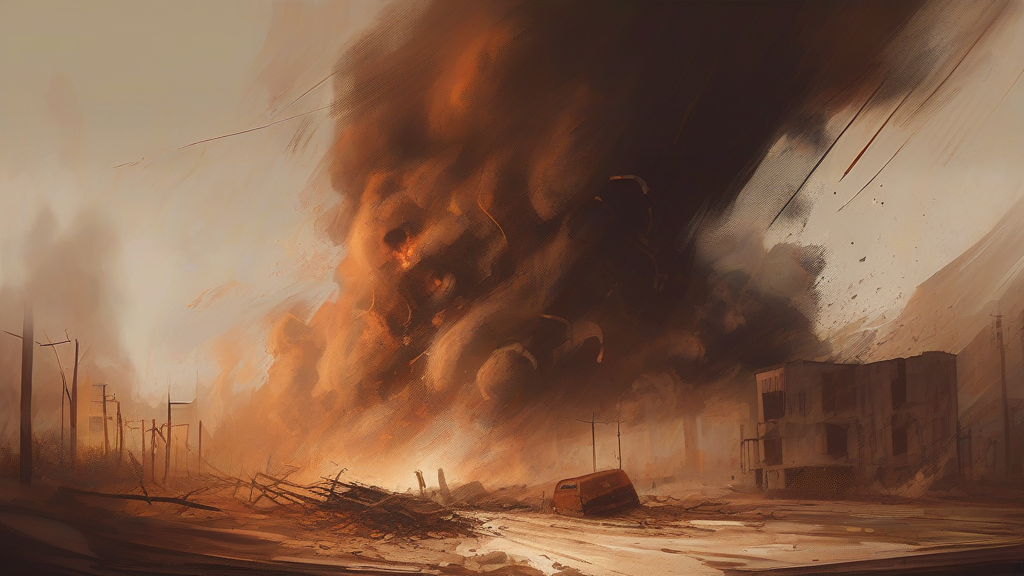
What does destruction mean?
Destruction is a noun referring to the act of destroying something or the state of being destroyed. It describes both the process — as in the demolition of a building or the deliberate wrecking of property — and the resulting condition of ruin, as when a storm leaves devastation behind. The word is standard across British and American English and appears frequently in news reporting on war, natural disasters, and environmental damage. Its connotations are overwhelmingly negative, evoking loss, violence, and irreversibility, which is why it pairs naturally with words like 'total', 'widespread', and 'massive'. Interestingly, its Latin root means to un-build or pull apart, making it the conceptual opposite of construction. Economists have even coined the phrase 'creative destruction' to describe how innovation dismantles old industries while creating new ones — a rare instance where the word takes on an almost constructive sense.
nounThe act or process of destroying something, or the state of having been destroyed; the action of demolishing or reducing something to ruin.
- The act or process of destroying something, especially deliberately or violently.
- The condition or result of having been destroyed; complete ruin or devastation.
"The hurricane left a trail of destruction along the entire coastline."
"The fire caused the total destruction of the historic library."
"War brought widespread destruction to cities that had stood for centuries."
The word 'destruction' literally means 'un-building' — it comes from Latin roots meaning to pull apart a structure, so every time you use it you're describing the undoing of construction itself.
Reviewed by Deb Chak, Editor. AI-assisted content curated by RJS Tech Solutions LLP.
Etymology of destruction
Destruction derives from the Latin 'destructio', a noun formed from 'destruere', meaning to tear down or unbuild — a compound of the prefix 'de-' (down, away) and 'struere' (to build, pile up). The word entered English via Old French in the Middle Ages and has been in continuous use since. It shares its root with words such as 'destroy', 'destructive', and 'structure', all tracing back to the same Latin verb 'struere'.
Related word forms
How destruction is actually used
A formal-to-neutral noun common in journalism, military and environmental reporting, and everyday speech. It carries strongly negative connotations of loss and violence, though phrases like 'creative destruction' (in economics) give it a more neutral, even positive framing.
Easily confused with destruction
Deconstruction is a method of critical analysis that breaks down ideas or texts to reveal their assumptions, whereas destruction is the physical or literal act of ruining something.