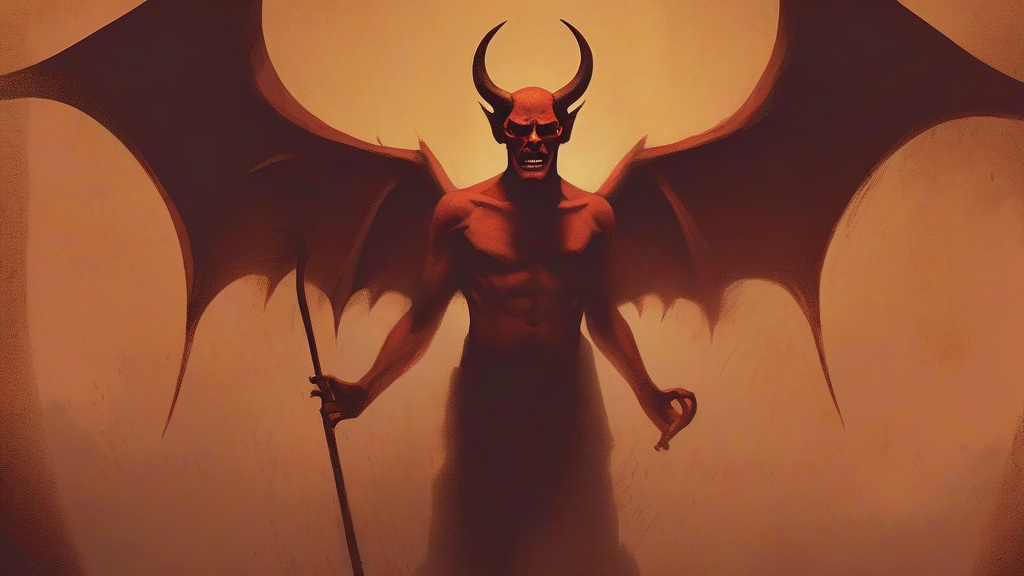
What does devil mean?
The devil is, in Christian and related religious traditions, the supreme spirit of evil — Satan, the fallen angel who opposes God and tempts humanity toward sin. More broadly, the word denotes any evil spirit or demon, and it extends figuratively to people: a cruel or wicked individual may be called a devil, while a mischievous child may be affectionately dubbed 'a little devil'. The word also functions as a mild expletive, appearing in expressions such as 'what the devil?' or 'the devil you did!', conveying surprise, disbelief, or irritation without causing real offense. English abounds in fixed idioms built around it — 'the devil is in the details', 'speak of the devil', 'give the devil his due', and 'between the devil and the deep blue sea'. Derived forms include 'devilish', 'devilry', and the culinary 'devilled', describing food seasoned with hot spices. Few English words carry as much religious weight, idiomatic richness, and everyday versatility.
The supreme spirit of evil in Christian tradition (Satan); an evil spirit or demon; a wicked or mischievous person; or a mild expletive expressing surprise or annoyance.
"According to the story, the farmer sold his soul to the devil at the crossroads."
Capitalized when referring to Satan; lowercase for generic spirits or figurative uses.
To prepare food with hot spices or condiments (chiefly British; usually in the form 'devilled').
"She served devilled kidneys at breakfast."
Rarely used as a bare verb today; almost always encountered in the participial adjective 'devilled'/'deviled'.
The plural applies to the general senses (evil spirits, mischievous persons); 'the Devil' as a name for Satan is normally singular.
"Medieval artists filled their canvases with winged devils tormenting sinners."
English speakers say 'the devil is in the details,' but the phrase began as 'God is in the details' — somewhere along the way, heaven got swapped for hell.
Reviewed by Deb Chak, Editor. AI-assisted content curated by RJS Tech Solutions LLP.
Etymology of devil
The word 'devil' derives from Old English 'dēofol', which was borrowed from Latin 'diabolus', itself taken from Greek 'diábolos' meaning 'slanderer' or 'accuser', from the verb 'diabállein', 'to throw across or calumniate'. In ancient Greek usage the term could describe anyone who slandered another before it became the standard translation for Satan in the Septuagint and New Testament. The same Latin root gives English 'diabolical', 'diablerie', and 'diabolism', making these the word's closest etymological relatives.
Related word forms
How devil is actually used
Lowercase 'devil' can refer to any evil spirit or to a mischievous person; capitalized 'the Devil' refers specifically to Satan. As an expletive ('what the devil', 'where the devil'), it is mildly informal but not offensive by modern standards. The culinary verb sense survives mainly in the adjective 'devilled' (British spelling) or 'deviled' (American), as in devilled eggs.
Easily confused with devil
A demon is any evil spirit or malignant supernatural being, while 'the devil' specifically names the supreme evil figure (Satan) in monotheistic traditions.