
What does dibbler mean?
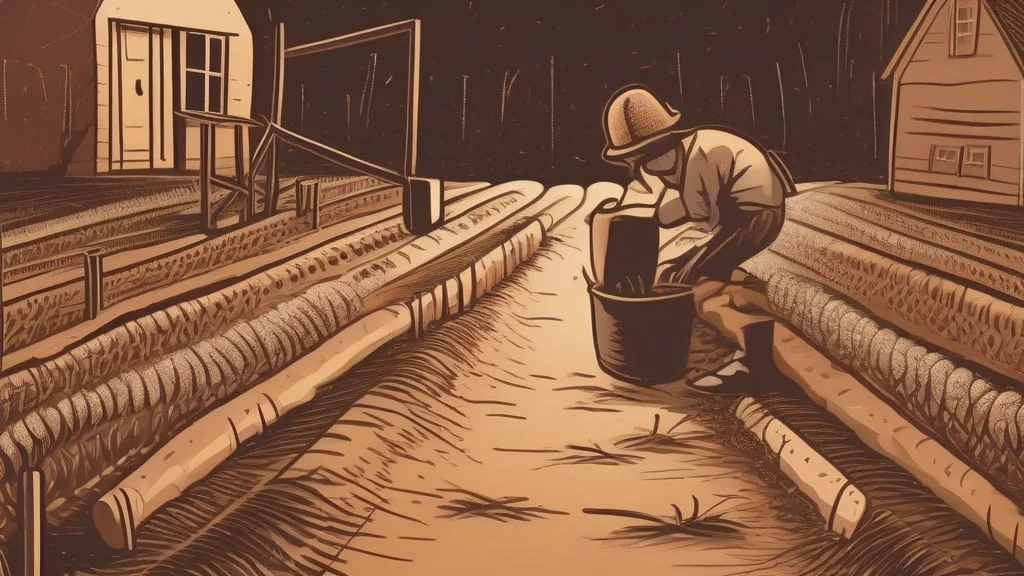
A dibbler is, most commonly, either a pointed hand tool used in gardening to bore small holes for seeds, bulbs, and seedlings, or the person who uses one. The tool — often simply called a dibber — may be little more than a shaped stick of wood or metal, sometimes marked to gauge depth, and it remains a staple of traditional sowing, especially for setting out leeks, onions, and other transplants at even spacing. The word derives from the verb 'to dibble', meaning to plant with such a implement, which dates back several centuries. Separately, 'dibbler' names a small, agile marsupial of southwestern Australia, Parantechinus apicalis, an insect-eating creature that has become a focus of conservation efforts after vanishing from much of its former range. In everyday use the gardening sense dominates, carrying a homely, old-fashioned flavor that evokes kitchen gardens and careful hands-on cultivation rather than mechanized farming.
A person who sows seeds by making small holes in the ground, or the pointed hand tool (a dibber) used to make those holes.
"Using a dibbler, he set each seedling into the bed at precise six-inch intervals."
In British English, 'dibber' is the more usual name for the tool; 'dibbler' can denote the tool or the person planting.
A small carnivorous marsupial (Parantechinus apicalis) of southwestern Australia, now restricted largely to offshore islands.
"Conservationists released captive-bred dibblers onto the mainland reserve."
This sense appears almost exclusively in Australian natural-history and conservation contexts.
Regular plural; applies to both the gardening tool/person and the marsupial.
"The shed held trowels, dibblers, and twine in tidy rows."
One 'dibbler' is a humble garden stick for poking holes — another is a rare Australian mouse-like marsupial that once survived on an island free of cats.
Reviewed by Deb Chak, Editor. AI-assisted content curated by RJS Tech Solutions LLP.
Where does dibbler come from?
The word 'dibbler' derives from the verb 'dibble', meaning to plant with a pointed implement, which appears in English from around the sixteenth century; the verb's ultimate origin is uncertain, though it may echo similar Germanic words such as Dutch 'dubbelen'. The agent-noun suffix '-er' produced both 'dibbler' for the person planting and, by extension, the tool itself. Entirely unrelated etymologically is the Australian marsupial called the dibbler, named for its habits rather than any connection to gardening.
Related word forms
How dibbler is actually used
In gardening contexts, 'dibber' is the more common word for the tool in British English, with 'dibbler' as a variant and also denoting the person doing the dibbling. The zoological sense is specialized, appearing mainly in natural-history and conservation writing about Australia.
Easily confused with dibbler
A dribbler is someone or something that drools or moves a ball in short taps, whereas a dibbler relates to planting holes in soil.
A nibbler takes small bites (or is a metal-cutting tool), while a dibbler is a planting tool, planter, or Australian marsupial.