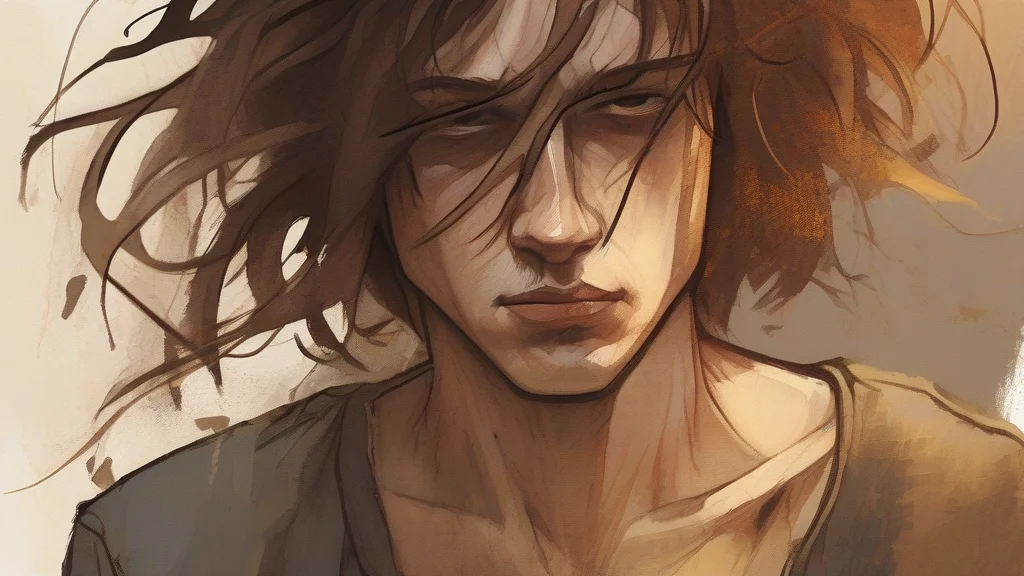
What does dishevelled mean?
Dishevelled describes someone or something that looks untidy, especially through hair that hangs loose or clothes that are rumpled and out of order. It is used almost exclusively of people's appearance — a dishevelled traveller stepping off a night train, a writer with dishevelled hair bent over a desk — and rarely of places or things. The word carries a mildly literary tone and tends to suggest picturesque disorder rather than genuine neglect: a person may look dishevelled after wind, sleep, exertion, or grief, without any moral judgement implied. British English doubles the final consonant ('dishevelled'), while American English prefers 'disheveled'; both are correct within their regions. The word derives from Old French, where it literally meant having the hair let down, from 'des-' (undoing) and 'chevel' (hair). Related forms include the verb 'to dishevel' and the nouns 'dishevelment' and 'dishevelledness', though the adjective remains by far the most common usage in modern English.
Untidy and rumpled in appearance; (of hair) hanging loosely or uncombed.
"He looked pale and dishevelled after working through the night."
Applies chiefly to people's hair, clothing, and overall appearance; British spelling uses double 'l', American single 'l'.
Past participle of the verb 'to dishevel', meaning to make (someone's hair or appearance) untidy.
"Her hair was thoroughly dishevelled by the gale-force winds."
Rare in modern usage; the passive construction is now usually expressed with adjectival force.
'Dishevelled' literally means 'hair-down': it comes from French roots meaning to let your hair fall loose — so calling someone dishevelled is, historically, describing a bad hair day.
Reviewed by Deb Chak, Editor. AI-assisted content curated by RJS Tech Solutions LLP.
Etymology of dishevelled
Dishevelled entered English in the late Middle Ages from Anglo-Norman and Old French, where 'deschevelé' meant having the hair uncovered or let down, formed from 'des-' (expressing reversal) and 'chevel' (hair), which itself descends from Latin 'capillus', meaning hair. The word originally applied specifically to women whose hair was unbound or uncovered, before broadening over the early modern period to describe anyone or anything generally unkempt. Its Latin root 'capillus' also gives English such words as 'capillary' and, via Old French 'chevelure', the rare term for a head of hair. The verb 'to dishevel' was formed later by back-formation, and it survives mainly in literary contexts.
Related word forms
How dishevelled is actually used
Standard in British English; American English overwhelmingly prefers the single-l spelling 'disheveled'. The word is mildly formal or literary in register and carries a slightly sympathetic or picturesque connotation rather than harsh criticism — it suggests charming disorder more than squalor. It applies most naturally to hair, clothes, and appearance, not to rooms or objects.
Easily confused with dishevelled
'Dishevelled' is simply the British spelling and 'disheveled' the American spelling of exactly the same word — neither is a different word or an error.